← The Books
Arche · The Setting

The Foot of Mount Phyle

Four mercenaries camped at the foot of a besieged hill, out of sight of one another, with word between them only by raven.

Read this first, and any book set at the foot can be read next, in any order. It describes the hill, the four camps and the ravens between them, which every book here takes for granted, and it says what each book changes.

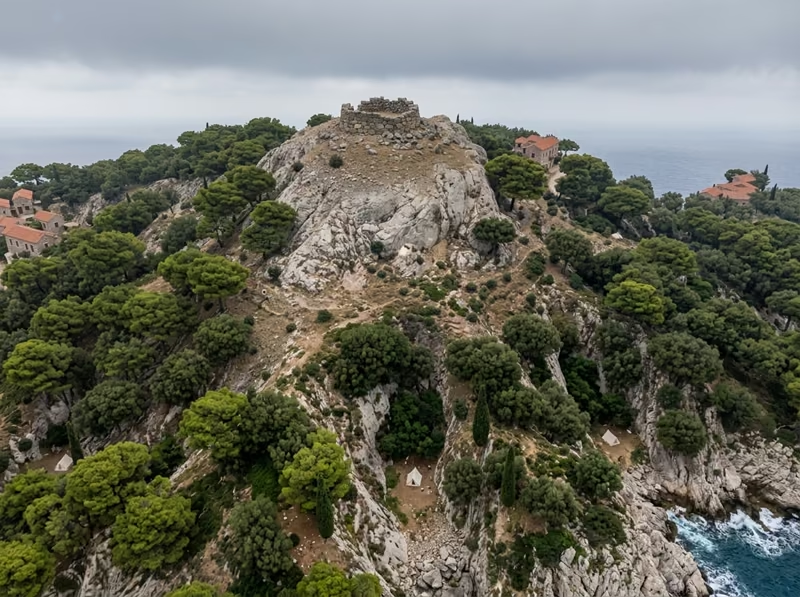
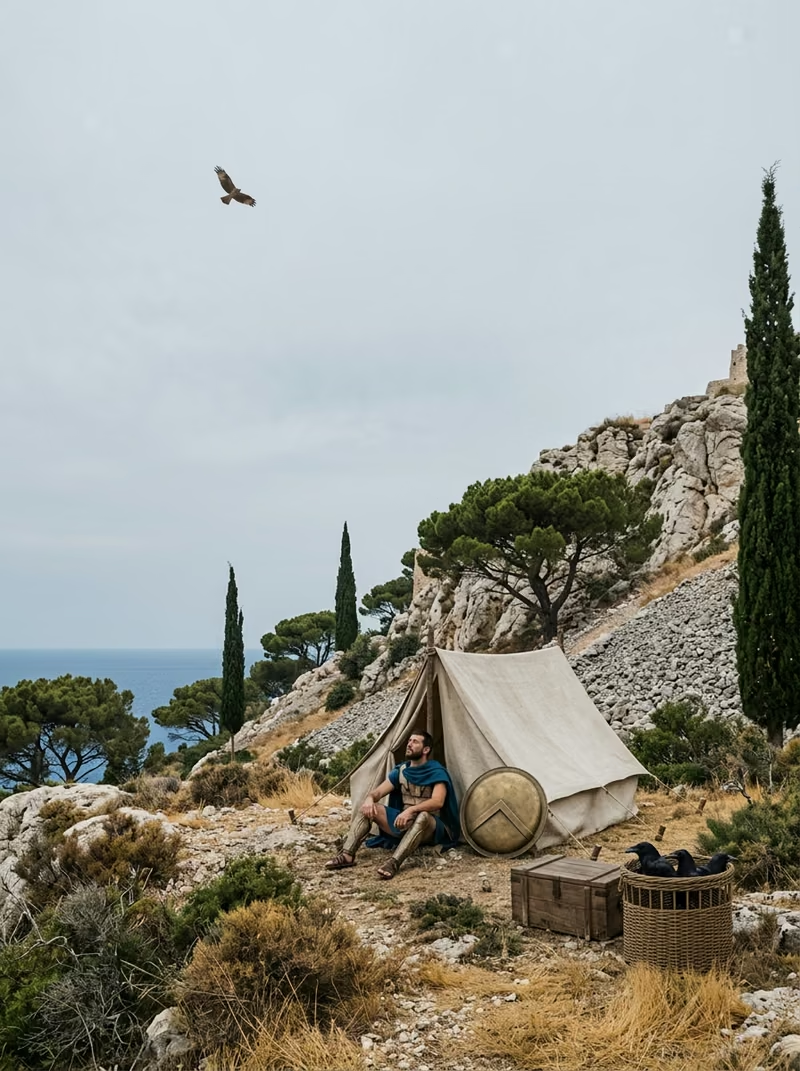
Mount Phyle under low grey cloud: wooded spurs and gullies run down from a small ruined ring wall on the top, lone tents far apart at the gully feet, a harbour town on the coast below.

The Hill

Mount Phyle is the limestone massif at the middle of Arche, broad enough to block every line of sight across the island. Eight wooded spurs run down from its top, with gullies between them, and the hill's own crows roost in the pines of the folds. On the very top is the crown: a small ruined ring wall, solid all round, with no way through.

The hill is under siege. The crown above is held by bandits with their loot, and the four at the foot have been hired by the houses of the ring road to clear them out. The siege has no end in any book: no assault is made, no wall is carried, and nobody surrenders. The books describe arrangements, not events, and nothing follows from any decision anyone reaches.

The Camps

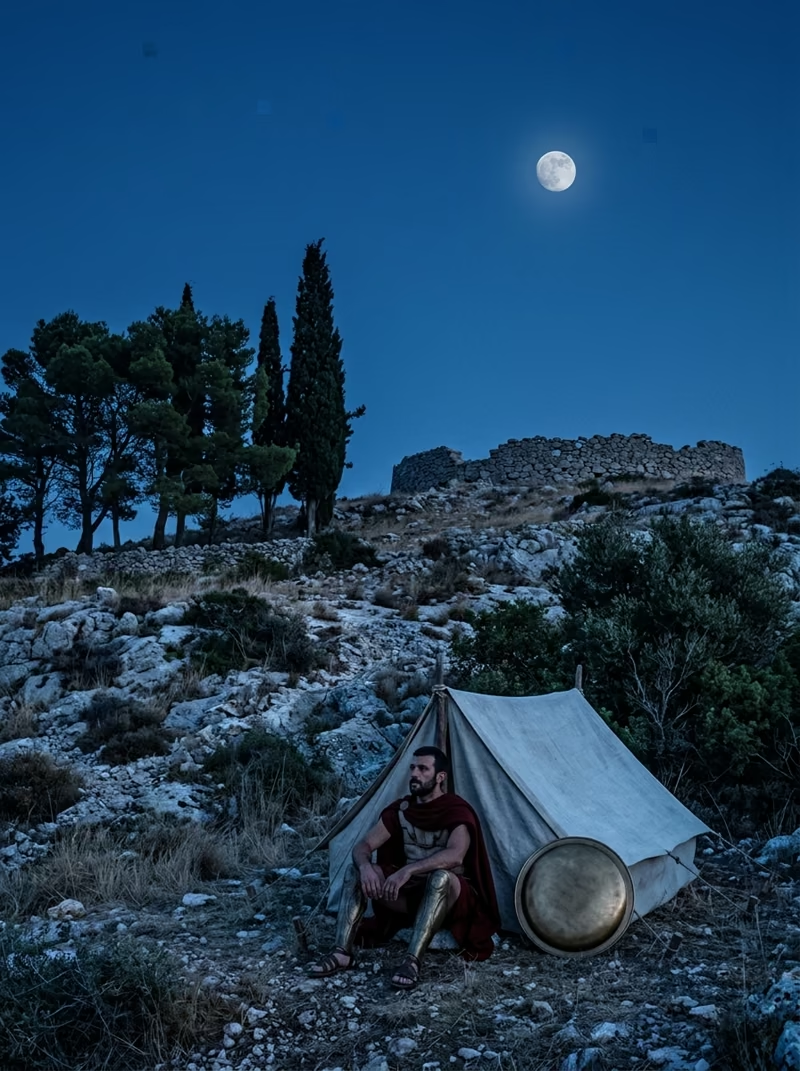
Four small tents stand at the foot of four gullies, at the four quarters of the hill, one mercenary to a tent. The tents are numbered 1 to 4, and each mercenary goes by his tent's number: Number 1 to Number 4. They are alike. The houses hired each of them separately and pay each separately; none commands another, and none of them lies.

Between any two tents stand two wooded spurs, so no man can see another. They light no fires and sound no horns, which would tell the hill where they are and that they are talking. And no man leaves his tent to carry word, because leaving it is how he commits to the very thing they must agree on.

Their question has two answers: attack or hold. The mercenaries do not know where the bandits' posts lie. All they have seen is that the bandits are few and scattered, too far apart to see or help one another, so an attack wins by beating them one at a time, all four together on whatever they meet first; fewer than four may meet more than they can handle. A hold wins if the bandits break out: each man lies by the path down his own gully. The four gullies with tents are the only ways off the hill, since the folds between them end in crags nobody can climb down, so with all four holding nobody comes off unseen, and a gully left empty is a way out. Neither answer is the better one, but half attacking while half hold is worse than either: too few to climb, and the hill left open. So all four must do the same thing. Committing is a definite act. A man who attacks strikes his tent and takes the path round the slope to the meeting place agreed beforehand, to climb with the others; a man who holds leaves his tent for the path down his gully and stays there. Either way he has left his tent and its birds, and he will not be back before dawn. What he thinks before that does not count.

Any of them may be killed. A dead man's tent simply falls silent. Nobody succeeds him and no bird goes out to report it, so to the others a dead man looks exactly like a live one whose bird has not yet come.

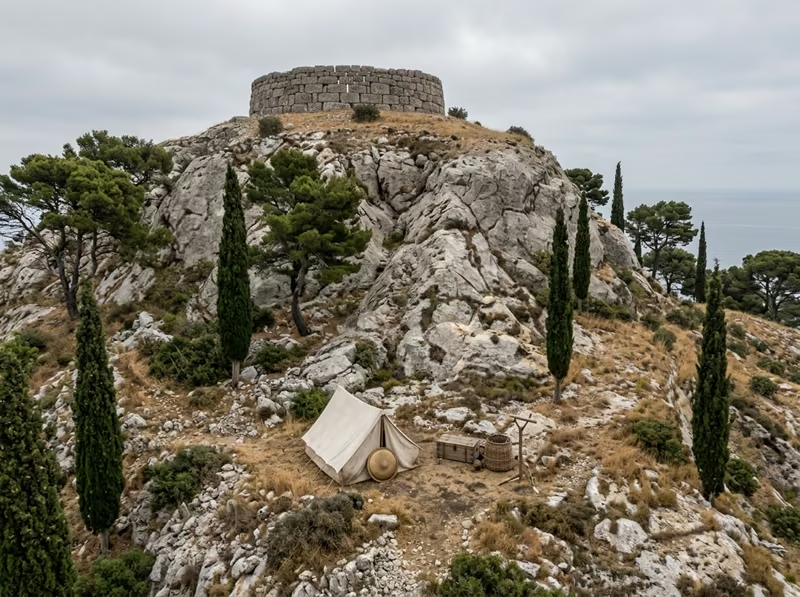
A single small tent at the foot of a wooded gully, with a shield, a chest and a bird perch beside it; far above on the skyline, the small round ring wall of the crown, closed all round.

Ravens

Word passes on the mountain only by raven. A man writes on a strip, rolls it into a bronze tube, ties it to the leg of a bird belonging to the tent or post he is writing to, and lets it go. What a bird carries is exactly what was written, and it is known whose it is.

How long a bird takes is where the books at the foot differ. On the first nights a bird may sit among the crows of the folds for an hour or for the night: there is no longest flight, and there is no timer at any tent.

A goatherd crossing the mountain by the smugglers' tracks may pass between the tents, but he takes as long as he takes and may never come down at all. A strip given to him would only be one more slow bird, less sure than a raven, and nothing on the hill either needs him or is changed by him. The camps carry nothing from one house of the ring road to another.

One Change a Night

Every book at the foot keeps the same hill and the same four at the same tents. What changes from book to book is one condition of the night, never the place.

The first nights: birds with no longest flight, and one man may die. Nothing else.
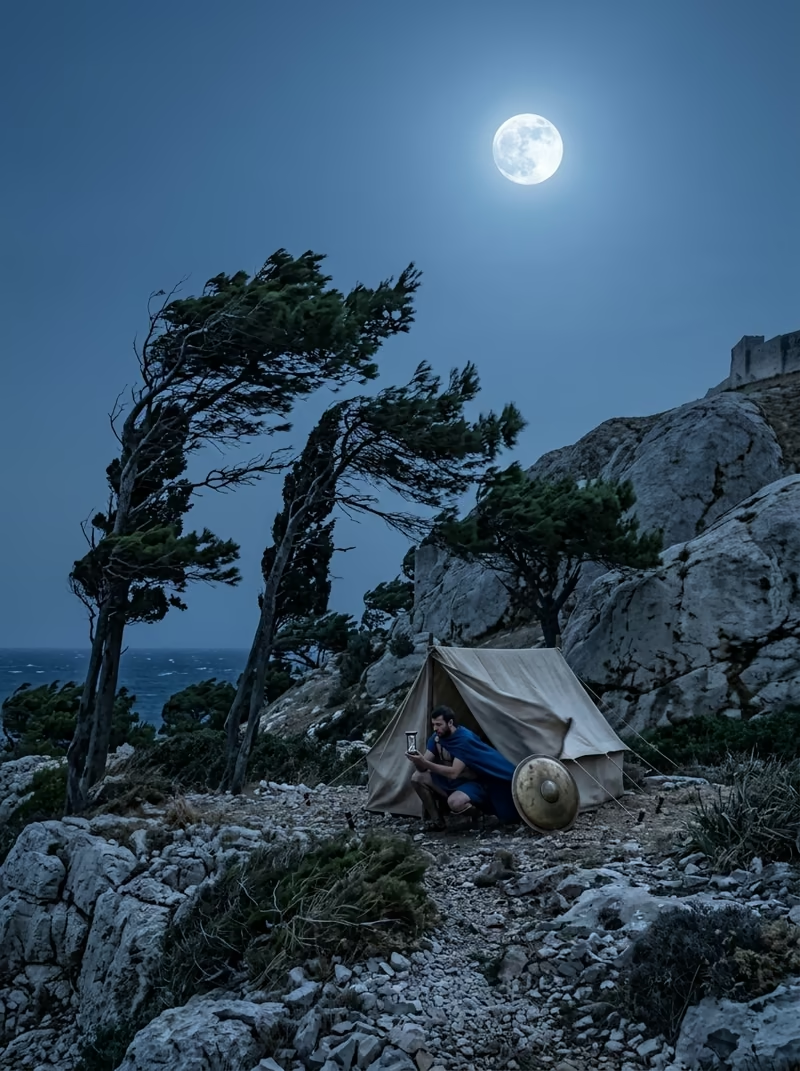
Windy nights: while a wind blows, a bird may sit it out for any time; the wind always drops in the end, and in still air every bird arrives within a glass. On these nights each tent has a glass, started as the last light left the crown.
Nights of lost birds: no wind, and a bird that arrives does so within a known flight, but a hawk may take any bird. The four keep a standing plan, attack or hold, that any of them may move or ask after.
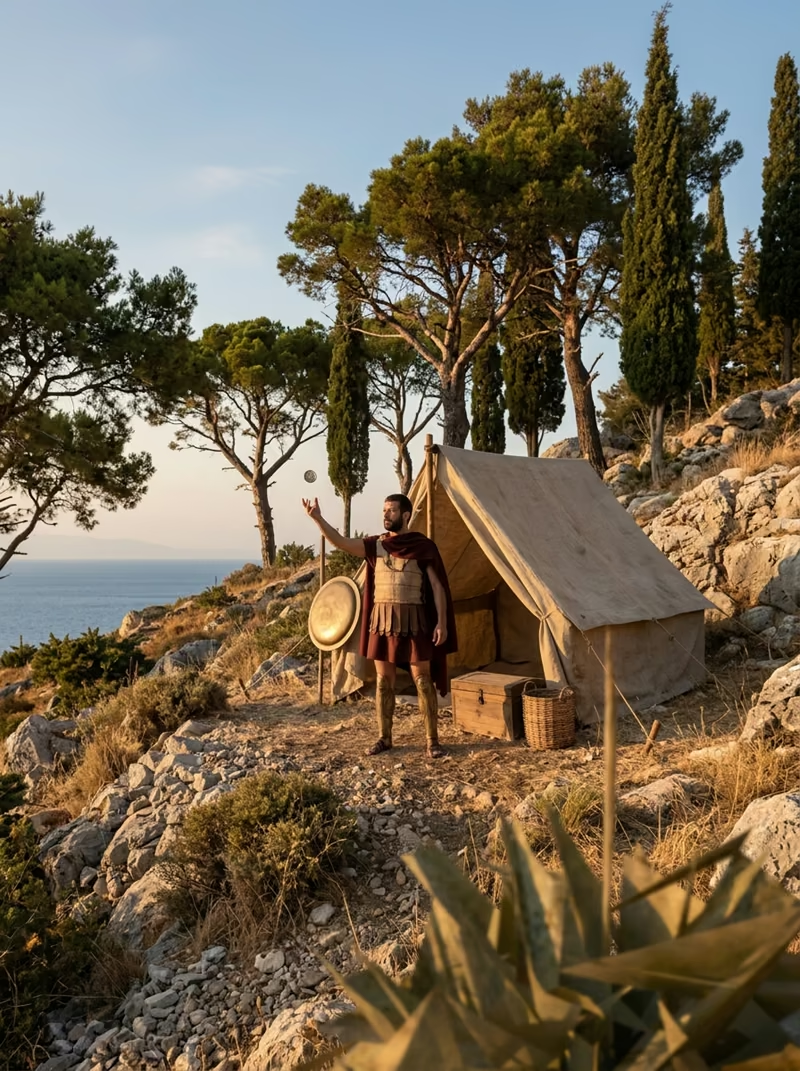
Nights of the coin: each man carries Attic silver and, when he cannot settle, tosses a coin alone in his tent.
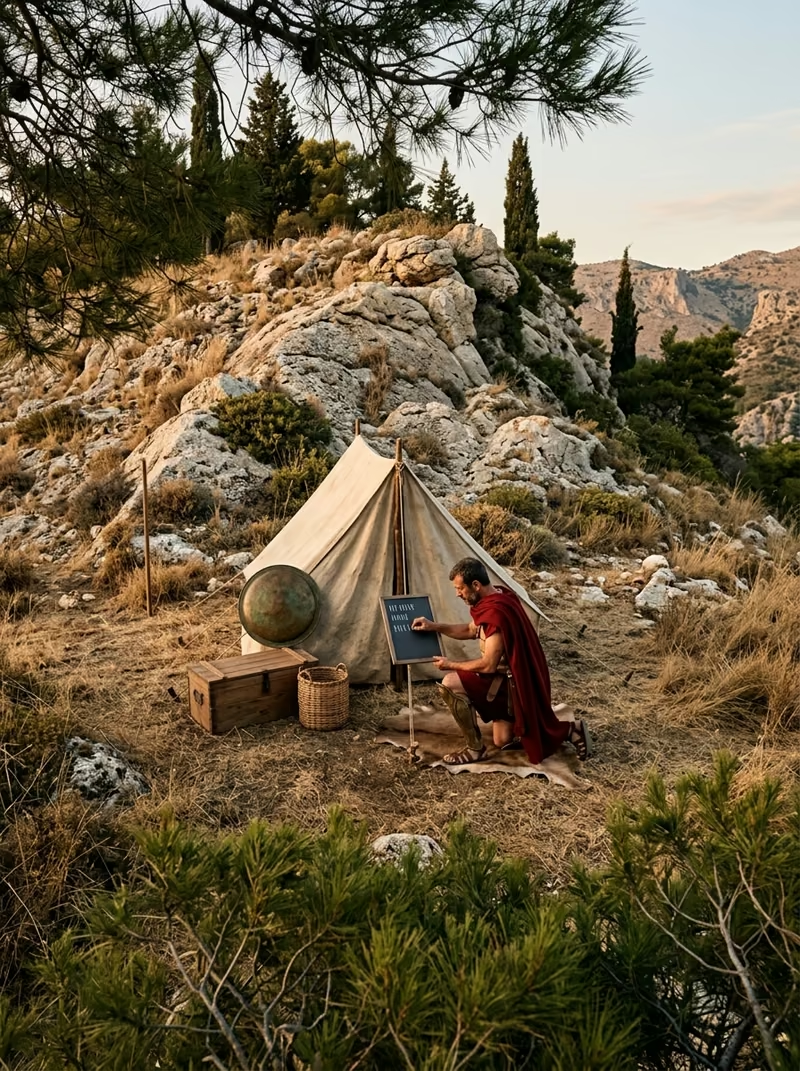
Nights of the slate: each tent keeps a slate, chalking the tents its man believes dead, often wrongly.

Whatever the night, nothing is ever settled by force, and the arrangements are judged only by what they guarantee.

The Setting and the Papers

What each part of the place stands for, so that a reader coming to any book here knows the model before the first chapter begins.

In the setting
What it stands for
the four mercenaries (Numbers 1–4)
⟷
Processes that may crash but never lie; no leader.
attack or hold; committing
⟷
Binary consensus; an irrevocable decision.
a dead man's silent tent
⟷
A crash failure, indistinguishable from a slow process.
ravens; a strip in a bronze tube
⟷
Point-to-point messages, never forged.
no longest flight
⟷
Asynchrony: no bound on message delay.
the wind that drops; a glass
⟷
Partial synchrony: a bound that holds after an unknown time.
a hawk taking a bird; a cut-off tent
⟷
Message loss; a partition.

Reality Checks

What each part of this place has in common with the real Greek world, so that a reader can tell what is borrowed from what is made up. Close means the real thing is much like it; loose means it is borrowed and changed; invented means the setting made it up; anachronism means the real thing is of another age. A dagger (†) marks a citation given from memory and not checked against the text.

In the settingThe real precedentHow close
Place. Mount Phyle, a hill held by a small bandPhyle is a real border fortress on Mount Parnes in Attica. In 404 BC Thrasybulus seized it with a small band of exiles, and an attack by the Thirty failed in a snowstorm (Xenophon, Hellenica 2.4.2–3). The setting borrows the name and the situation of a small garrison on a hill that a larger force cannot take.Close
Place. four camps with no pair in sight of one anotherGreek armies camped in separate contingents round a besieged place; the Peloponnesian lines at Plataea are the standard example (Thucydides 2 and 3)†.Loose
Character. four mercenaries, one man to a tent, no leaderXenophon's Ten Thousand were hired for pay (a daric a month, Anabasis 1.3.21). When their generals were killed the army elected new ones and voted its decisions in assembly (3.1.46–47)†. Each man being hired separately is the setting's own.Close
Character. the four told apart by tunic colourSoldiers were not generally in uniform, but Sparta's crimson cloak is the famous case of a colour that identifies a body of men (Xenophon, Constitution of the Lacedaemonians 11.3).Loose
Prop. a wind that dropsThe Aegean's summer north wind (the etesiai, now the meltemi) blows by day and tends to die away at dusk†, and the Tower of the Winds in Athens names eight winds.Close
Prop. a linen tent, a plain bronze-faced shield, a chest, a wicker basketThe skēnē (tent), the aspis (the round shield, bronze-faced in Sparta's case, Xenophon 11.3), the chest and the basket are all ordinary kit†.Close
Prop. ravens carrying messages, a strip in a bronze tubeReal ravens do not carry messages, as the setting says. The real bird is the pigeon: Taurosthenes of Aegina is said to have sent news of his Olympic win home to his father by a pigeon on the same day (Aelian, Varia Historia 9.2; Pliny, Natural History 10.53). Apollo's raven is a mythical messenger (Hesiod fr. 60)†.Loose
Prop. a glass, started at last lightThe hourglass is not attested before the fourteenth century AD (its earliest evidence is Lorenzetti's fresco of 1338), and the Greek instrument is the water-clock. The setting keeps the sandglass on purpose, a deliberate anachronism for narrative convenience: it can be turned over at a stroke, so that four men who cannot see one another start together.Anachronism
Prop. the slate on which a man chalks the tents he thinks deadGreeks wrote notes on wax tablets, whitened boards and potsherds; chalk on slate is not attested for them†. The slate is a convenience of the allegory.Loose
Practice. one tent's roll is the only note that counts: the muster-masterArmies kept muster rolls, and pay was drawn up from them; the rolls of the Ptolemaic army are known from papyri†. That one man's roll settled a fact for the whole company is the setting's use, and a muster-master with no say in what the company does is the setting's own.Loose
Prop. a coin: owl for hold, goddess for attackThe Athenian silver tetradrachm showed the head of Athena on one side and her owl on the other, and was accepted as money across the Greek world. The pairing with the two answers is the setting's own.Close
Practice. no fire and no signal, because the other side is listeningFire signals were real: the beacon stations of the Cyclades were called phryktoriai, and Polybius describes a signalling code (10.43–47). The weakness of fire signals is that the enemy can read them too.Close
Practice. a hill that cannot be left unwatched, attack or holdCouncils of commanders voted on whether to fight or withdraw: Herodotus's account of the council before Salamis is the model (8.49–63)†.Close
Practice. a man who cannot settle tosses a coinGreeks decided by lot (the klērotērion) and played ostrakinda, in which a shell black on one side and white on the other was tossed while a player called “night” or “day” (Pollux 9.111, a later account of an older game). The coin toss as a decision rule is Roman, “heads or ships”†.Loose
Practice. the glasses started together as the last light leaves the crownThe civil day began at sunset in Athens†, so a common moment fixed by the evening light is a real one.Close

The Books Set Here