When one part of a system is cut off from the rest, should it keep answering and risk being wrong, or stay silent until it can be sure? Can it ever have both?
We find out by exploring what the same Greek mercenaries could promise one another about their standing plan when ravens were lost and one tent was cut off.
After Eric A. Brewer, Towards Robust Distributed Systems, 2000 · Seth Gilbert and Nancy Lynch, Brewer's Conjecture and the Feasibility of Consistent, Available, Partition-Tolerant Web Services, 2002

Each link is an idea one paper took from another. Point at one, or tap it, to read how.
a paper this book retells a paper retold in another book a paper outside the series
A service stores copies of its data on several machines, and clients may read or write at any of them.
Three things are wanted of such a service. Every read should see the latest completed write, as if there were one copy. Every request to a working machine should be answered. And both should hold although the network may lose messages, even every message between two groups of machines.
So the choice comes when the network splits, and what is left to settle is which wish to give up and for how long. We tell it with four mercenaries, their ravens, and a plan they share between them.
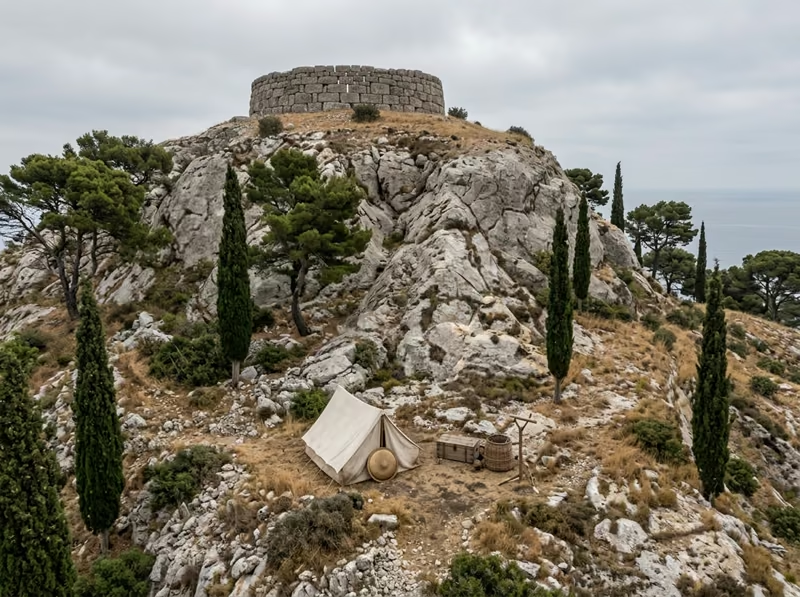
Four mercenaries are camped at the foot of Mount Phyle, one to a tent and under nobody's command.* Bandits hold the top of the hill, and the four must all attack or all hold. The tents cannot see one another, so word passes between them only by raven.
Until they commit, the four have a standing plan: the answer they mean to commit to, as things stand. At dusk it is hold.
Any man who sees something on their side of the hill may move the plan to the other answer, and any man may ask which plan stands. Each tent has its own note of it. A move is done when the man who made it is told it stands, and a question is done when the man who asked is told attack or hold. Nobody commits in this book, and nothing follows from which plan stands. What matters here is only what each man is told.
These nights differ from the others at the camps in one thing: a raven can be lost. A hawk may take it in the folds, and it never arrives. Nobody sees a bird taken, so a man waiting on a bird learns it was lost only when longer than any flight has passed and it has not come, and even then learns nothing of what it carried. On some nights every bird between one tent and the other three is lost, for as long as the hawks keep to that fold. That tent is cut off.
Send a bird below with no hawks about, and it lands within a flight. Then bring the hawks to tent 4's fold, send a bird from tent 2 to tent 4, and let a flight pass. Number 4 learns that a bird was lost, and nothing more.
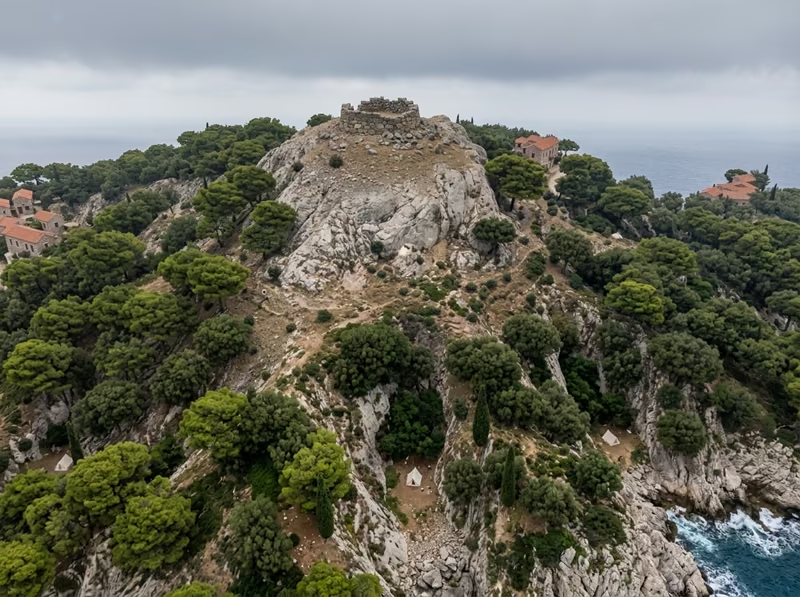
The hill from above. A raven is a dot flying round the hill between two tents. While hawks are in the fold of tent 4, every bird to or from tent 4 is lost.
Send a bird, and see whether it comes.
On the night this book is about, tent 4 is cut off. Number 4 is alive and well and in the tent, wants to know which plan stands, and wants to know now. Something has to be said to Number 4, and the four have not yet settled what they owe a man who asks.
What the four owe a man who asks comes to two debts, and both must be paid while birds can be lost.
The first debt is about what an answer says, and the second is about getting an answer at all. The condition is the hawks.
Each tent has its own note, but the plan behaves as one plan. Every move and every question, at all four tents, fits one order in which a single record would have given every answer, each taking effect at a moment between its start and its answer, and anything finished before another began coming first.* If Number 2 has moved the plan to attack and been told it stands, a man who asks afterwards must hear attack, or a later move.
A man who asks, or moves the plan, is answered in the end, from what their tent holds. No limit is set on how soon, only that the answer come.
A hawk may take any bird, on any night. The two debts must be paid all the same.
Two ways of answering look safe, and each leaves one debt unpaid. Suppose Number 2 has moved the plan to attack and been told it stands, and Number 3 asks afterwards. A tent that says hold to every question has answered, but wrongly whenever attack stands. A tent that waits until the hawks leave has said nothing wrong and has not answered either, since the hawks may stay all night. Try both below.
Number 2 has moved the plan to attack and been told it stands. Later Number 3 asks which plan stands.
The four have two things in their favour on these nights. Each tent has a sandglass. The glasses run alike, so a man can measure how long they have waited, though no man can tell what another's glass shows. And no wind blows, so a bird that arrives does so within a known flight. That is the calm of a windy night once the wind has dropped,* and here it holds from the start. The wind comes back at the end of the book.
That makes three things to promise together: answering as one, answering every man, and doing both while birds can be lost. Whether the four can promise all three is still open.

Gilbert & Lynch's partially synchronous model with arbitrary message loss, §4.1: a known bound tmsg on delivery of messages that are not lost, and local timers at the same rate.
The four cannot promise all three. Of answering as one, answering every man, and carrying on while birds can be lost, they may have any two. The impossibility was first put as a claim, and only later proved.
The Cut-Off Tent. When birds can be lost, no arrangement of the four can both answer every man and answer as one, even with a known flight and glasses in every tent.
The proof takes two nights that begin alike, with the plan at hold and tent 4 cut off. On the first Number 2 moves the plan, and on the second nobody does. Scroll through them, and watch what Number 4 has to go on each night: the note in the tent, the glass, and whatever birds have come in.
The plan stands at hold. Every bird between tent 4 and the other three will be lost, for as long as this lasts.
Number 2 moves the plan to attack. Every man is answered, so Number 2 is told it stands. Whatever birds go to tent 4 are lost. Nothing else happens anywhere.
The same dusk, and nothing happens anywhere for at least as long as the first night's move took. Then Number 4 asks which plan stands, and is answered. Nobody moved it, so a single record says hold.
Let the first night happen among the three and the second at tent 4. Nothing reaches tent 4 in either. Number 4 has the same note, the same glass and no bird, and asks after Number 2's move was finished.
Number 4 cannot tell this from the second night, so says what was said there: hold. But Number 2's move was finished before Number 4 asked, and a single record would say attack. The arrangement does not answer as one.
Number 4 did not answer badly. Everything on Number 4's side of the lost birds is the same on both nights, so Number 4 must give the same answer on both. On the second night hold is exactly right. The two nights want different answers, and the answer that is right on the second breaks answering as one on the first.
A known flight and glasses that run alike were both given to the four in the proof, and neither helped. What Number 4 lacks is news, and no amount of waiting brings a lost bird. Nor does the proof need tent 4 to be alone. With any division of the four into two sides the argument is the same.
So the four cannot have all three. Which two they may keep, and by what arrangement, is the next thing to settle.
In the paper's terms the tents are nodes, a lost bird is a lost message, a cut-off tent is a partition, answering every man is availability, and answering as one is atomic consistency. Theorem 2. In the partially synchronous model, with a known bound on delivery of messages that are not lost and local timers at the same rate, no algorithm guarantees both availability and atomic consistency in all executions, including those in which messages are lost. The two nights are the paper's executions α₁ and α′₂, put together they are its α, and T below is a time measured by the glass.
The four cannot have all three, but they can have any two, and one arrangement gets them most of the way. It gives one tent a single job: to be the muster-master, the only tent whose note of the standing plan counts.
Why the four need one. When every tent has its own note, the notes can drift apart. Number 2 moves the plan to attack, and for a while only tent 2's note says so. A man who asks at tent 3 in that while reads hold from a note that is out of date, and nothing in the camp is wrong except that two notes disagree. Answering as one asks that every answer be what a single record would say, and with four records there is no single record to say it. The surest cure is to have only one.
What the muster-master is. Say it is tent 1. The muster-master is no wiser or higher than the others, and Number 1 is a man like the rest, with no vote and no say in the plan. The muster-master is a role, and the whole of it is to hold the one note that settles what the plan is. The notes at the other three tents are no longer the plan. At most they are what the muster-master last sent there, to read back, and a man never answers from them alone.
What the muster-master does. A man at any other tent who moves the plan sends a bird to tent 1 and waits. Number 1 changes the note and sends a bird back saying it stands, and only then is the man told it stands. A man who asks does the same: the bird goes to tent 1, Number 1 reads the note and sends back what it says, and the man is told that. Say Number 2 moves the plan to attack and is told it stands. When Number 4 asks afterwards, the bird to tent 1 finds the note at attack, and attack is what comes back. A man at tent 1 has no bird to send and is answered on the spot.
Why one order comes of it. The muster-master deals with birds one at a time, in the order it takes them in. Every move and every question therefore falls into one order, the same whichever tent it came from, and each answer is read from the one note as it stood at that point in the order. Two birds that reach tent 1 together may be dealt with either way round, since the men who sent them were each still waiting and neither was finished before the other began. Where one man's business was finished before another's began, its bird was dealt with first. That is what answering as one asks for, and it holds with no hawks and with hawks alike.
What it costs. Every man but Number 1 is answered only when a bird has gone to tent 1 and come back. While the birds fly, every man is answered. When the hawks take a bird, the man who sent it hears nothing, because nothing in his own tent can answer for the muster-master. A tent cut off from tent 1 falls silent, and if tent 1 is the one cut off, the other three do. Answering as one stays whole, since every answer that is given is the muster-master's. What is given up, on the nights and at the tents the hawks cut off, is answering every man. The muster-master's arrangement pays the first debt in full and the second only as far as the birds allow.
The other pairings of the three have their arrangements as well.
When tent 4 is cut off, Number 4's bird does not arrive and Number 4 is not answered, so the tent in effect falls silent. Every answer that is given is right. When no bird is lost, every man is answered.
This pair asks for nothing new. With no bird lost, every bird reaches the muster-master and every answer comes back.
Let each man answer from their own note, whatever it says. Every man is answered at once, and answering as one is given up. In the worst case a man who has heard nothing since dusk says hold all night.
The three nights below put the same business to each arrangement: Number 2 moves the plan to attack, and Number 4 asks later. Choose a night and watch which of the three things is kept, and which is given up or goes untested.
Choose a night.
Each of these choices is made once and followed every night. A camp that answers from its own notes can be wrong on a night when every bird arrives. Most nights no fold has hawks in it, and the four would be giving up answering as one on all of them because birds may be lost on some.
The centralized algorithm, §3.2.1–3.2.2.
In the paper's terms the muster-master is the designated node of the centralized algorithm, and answering as one is atomic consistency. Claim. Ordering all moves and questions by the moment the muster-master dealt with them, every answer is what a single record would say, each takes effect between its start and its answer, and anything finished before another began comes first.
The four need not give up answering as one on every night. On a night with no hawks the muster-master's arrangement already gives answering as one and an answer for every man.
What the four want is to lose answering as one only while birds are actually being lost, and to answer every man throughout. They can, because a bird that arrives does so within a known flight. A man who has waited two flights and the muster-master's time to answer, and has heard nothing, knows that a bird was lost and can stop waiting. Three rules make use of that.
A man who moves the plan or asks sends a bird to the muster-master and starts a glass that runs for two flights and the muster-master's time to answer.
If the muster-master's answer comes before the glass runs out, the man takes it.
The man answers from their own note. A question gets the latest plan the muster-master has sent them, unless they have themselves moved the plan since, and then it gets their own move. A move is told it stands.
Earlier on the night below Number 2 moved the plan to attack, and tent 4's note still says hold. Bring the hawks to tent 4's fold and let Number 4 ask or move the plan, and watch the glass run out. With no hawks about, the muster-master's answer comes before it does.
Waiting a glass works for a plain reason. When no bird is lost, no glass runs out, and the arrangement is the muster-master's, which answers as one. When a bird is lost, the glass runs out and the man answers anyway, so every man is always answered. On any night on which no bird is lost, then, every answer is as one.
The Cut-Off Tent still stands. On its first night Number 4's glass runs out and Number 4 says hold, as that result says any arrangement answering every man must. What waiting a glass buys is that this happens only on nights when birds are actually lost.
Waiting a glass buys nothing after a loss. If Number 4 moved the plan while cut off, the muster-master never heard of it, and nothing here tells the muster-master. Long after the hawks have gone, the others are told a plan Number 4 has moved away from. The picture shows it: move the plan from tent 4 under the hawks, send the hawks away, and let Number 2 ask. The promise covers whole nights on which no bird is lost, and says nothing about the glasses that follow a loss.
The hawks may have left long ago, and a man's note may still be hours behind. What the four lack is a promise that the damage ends.
A timeout of 2tmsg + tlocal, §4.3.
The four can promise the damage ends, and the promise has a span of time in it, fixed in advance and measured by the glass. A loss does its damage only while it lasts and for the span after. Nobody can promise how long the hawks stay. The four promise only how long they take to catch up.
Catching up means that a move made without the muster-master reaches the muster-master, and then every tent. At the camps birds come in any order, so a man cannot count on an earlier bird arriving first. Every bird a man sends the muster-master therefore carries, before anything else, all the moves that man has made that the muster-master has not yet acknowledged, in the order they were made. The muster-master stamps each move as it comes in, and every bird from the muster-master carries the plan and its stamp, so that a man can go by the plan with the highest stamp to have come. Scroll to watch a move that Number 4 made while cut off find its way round.
Hawks are in the fold of tent 4. Number 4 moves the plan to attack and sends the move to the muster-master. The bird is lost. After a glass Number 4 is told it stands.
Number 4 sends the move again and again, often enough that with no bird lost it would reach the muster-master within half the span. Each bird is lost while the hawks stay.
The next bird after the hawks leave reaches the muster-master. The muster-master changes the note and gives the move the next stamp.
The muster-master sends the plan and its stamp to every tent, again to any that has not acknowledged it, often enough that with no bird lost they arrive within half the span.
From the moment the hawks left, a span longer than the promised one passes with no bird lost. Everything the loss did is now mended.
A question begun after that span is answered with Number 4's move or a later one. Here Number 3 asks, and is told attack.
The Span. The muster-master's arrangement with a span answers every man, answers as one on any night on which no bird is lost, and on every night keeps the promise of the span. The damage lasts only as long as the loss and a span after.
The picture leaves one thing out. All through the loss, the three went on moving and asking through the muster-master. Take Number 2 moving the plan to hold while Number 4, cut off, moves it to attack. The muster-master stamps both once Number 4's bird arrives, and the plan ends at whichever move was stamped later, so the promise is kept. For a while, though, two men are each told a different plan stands, and no promise about when they learn of it undoes that. Step through it below.
Every part of this leaned on a known flight: the glass that runs out, the birds sent again often enough, and the span itself. A windy night has no known flight, and what is left of the promise then has still to be seen.
All the moves and questions can be set in one order P, with t the span, fixed in advance and measured by the glass, in which:
Delayed-t consistency, Definition 3.
At every tent, always: every bird from the muster-master carries the plan and its stamp, and a man goes by the one with the highest stamp to have come. Every bird a man sends the muster-master carries all that man's unacknowledged moves, in order.
A question: send to the muster-master and wait a glass. If the muster-master answers in time, give that answer. If not, give the latest of the asker's own unacknowledged moves, or if there is none, the plan with the highest stamp the asker holds.
A move: send to the muster-master and wait a glass. It stands when the muster-master acknowledges it or the glass runs out, whichever is first. Until acknowledged, send it again, often enough that with no bird lost it reaches the muster-master within half of t.
At the muster-master: each move that reaches the muster-master, taken in its sender's order, changes the muster-master's note and takes the next stamp. The muster-master sends the plan and stamp to every tent, again and again to any that has not acknowledged it, often enough that with no bird lost they arrive within half of t.
The modified centralized algorithm, Theorem 4.
In the paper's terms (Definition 3 and Theorem 4), t is the span, fixed in advance and measured by the local timers, and P is an order on all the moves and questions of a night. Claim. On every night the muster-master's arrangement with a span answers every man, and admits an order P satisfying clauses (1) to (5) of the promise of the span, stated above.
The paper's own proof of this is a few lines long, and says nothing about how a man should treat moves of that man's own that the muster-master has not yet acknowledged; the second step supplies it.
A known flight is what a wind takes away, and waiting a glass does not survive it. A glass that runs out means a bird was lost only because there is a known flight.
On a windy night there is none. A bird may sit in the pines for any time, and a man who has waited any length of time cannot tell a lost bird from a slow one.* Then something stronger is true.
The Wind. If flights have no bound, no arrangement that answers every man can answer as one even on the nights when no bird is lost.

The two windy nights below look the same from tent 4. On one a hawk takes Number 4's bird, and on the other the bird sits out the wind in a pine. Let Number 4 ask and wait, have Number 4 answer, and then let the night go on.
Suppose a hawk takes the bird.
Suppose the bird sits out the wind in a pine.
Number 2 has moved the plan to attack and been told it stands. Number 4 now asks which plan stands.
On the second night no bird was lost, and the wrong answer was given all the same. Number 4 had to answer before the slow bird landed, and could not tell that night from the first. So in a wind an arrangement that answers every man can be wrong even on a night when every bird arrives. The results go no further than this, and it is worth marking where they stop.
In the paper's terms a night is an execution, and in the asynchronous model there is no bound on message delay. Corollary 1.1. No algorithm that guarantees availability in every execution guarantees atomic consistency in every execution in which no message is lost.
The Cut-Off Tent is easily taken for more than it says. Four questions mark where it stops.
The camps' impossibility is a different result. With one man who may fall silent and no longest flight, the four cannot be sure of ever committing.* That has the same shape as the Cut-Off Tent: something that must never go wrong, and something that must in the end happen, which cannot both be promised. But neither result gives the other. There, no bird is lost and one man may stop. Here, no man stops and birds are lost instead.
The result is about a living man. A man who has stopped owes no one an answer. Number 4 is alive and wants to know, and that is why the question has to be put to tent 4 at all.
A thing that needs no news is outside the result. Which number each tent bears never changes, and any man, cut off or not, can say so and be right. The result is about a plan that can be moved, where one tent needs news of the others.
The four need not choose once for all. They may answer as one for the standing plan and answer at once for something that matters less, or answer questions from their own notes while moves wait for the muster-master. Each such division gives up a little of both, and each is still bound by the Cut-Off Tent wherever a man answers from a note that may be behind.
Read the foot of the hill again with machines in the tents. Every tent is a machine holding a copy of the data, every raven is a message, and a cut-off tent is a part of the network that no message reaches or leaves. Hover over a row, or tap it, to see who is who.
A service cannot be consistent, available and partition-tolerant at once.
Since networks do partition, the real choice comes when one does: refuse some requests to keep every answer consistent, or answer every request and let the copies diverge.
This is one case of a wider fact: a safety property and a liveness property often cannot both be guaranteed. Real systems divide the trade-off by data or by operation.
Setting The Foot of Mount Phyle
Eric A. Brewer, Towards Robust Distributed Systems. Invited talk, 19th ACM Symposium on Principles of Distributed Computing (PODC), Portland, Oregon, July 2000. — The conjecture: of consistency, availability and tolerance to network partitions, a shared-data system can have at most two; the three cases and their examples.
Seth Gilbert and Nancy Lynch, Brewer's Conjecture and the Feasibility of Consistent, Available, Partition-Tolerant Web Services. ACM SIGACT News 33, 2 (June 2002), 51–59. — The formal model, the impossibility in the asynchronous and partially synchronous models (Theorems 1 and 2, Corollary 1.1), the centralized algorithm, and Delayed-t consistency (Theorem 4).
Seth Gilbert and Nancy Lynch, Perspectives on the CAP Theorem. IEEE Computer 45, 2 (February 2012), 30–36. — CAP as a trade-off between safety and liveness, its relation to FLP, and the ways real systems divide the trade-off.
The ideas, plainly. In 2000 Eric Brewer conjectured that a shared-data system can have at most two of three properties: consistency, availability, and tolerance of network partitions. Gilbert and Lynch made the conjecture precise and proved it. Consistency is atomicity, or linearizability: the system behaves as if there were one copy of the data. Availability means every request received by a working node eventually gets a response. Partition tolerance means these hold even though the network may lose any messages, including every message between two groups of nodes.
The proof is a single indistinguishability argument. Cut the nodes into two groups and lose every message between them. A write completes in one group; later, a read arrives in the other. That group cannot tell this execution from one with no write, so if it answers at all, it is wrong. Timers and a known delivery bound do not help, because the missing information cannot arrive.
Any two of the three can be had. A single designated node gives consistency always and availability whenever there is no partition. With timers and a delivery bound, a node can time out and answer locally only when messages are actually lost, and Delayed-t consistency bounds how long stale answers persist once the partition heals. Without a delivery bound, even that is impossible.
CAP is one case of a wider fact about unreliable systems: a safety property and a liveness property often cannot both be guaranteed. Real systems divide the trade-off by data or by operation.