Four bandits holding the crown of a besieged hill with their loot, at posts out of sight of one another, with word between them only by rat.
Read this first, and any book set on the crown can be read next, in any order. It describes the hill, the crown, its four posts and the rats between them, which every book here takes for granted, and it says what each book changes.

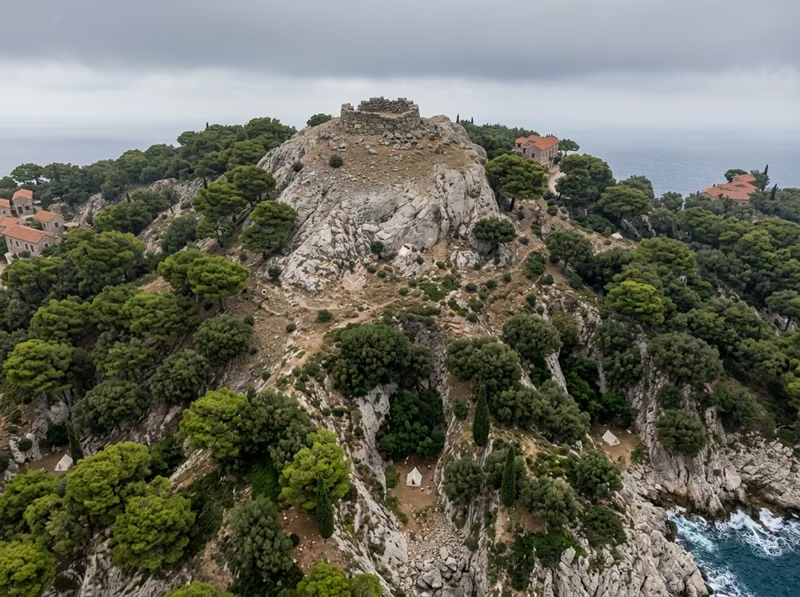
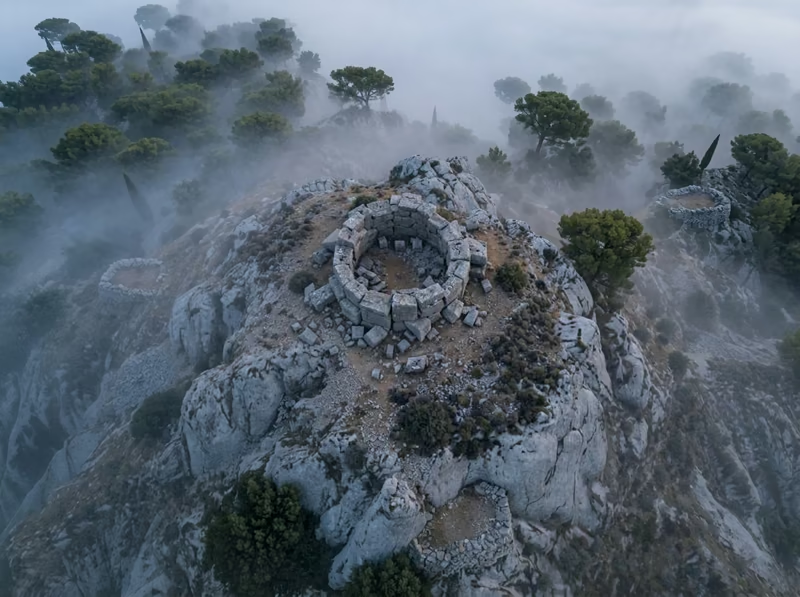
Mount Phyle is the limestone massif at the middle of Arche, broad enough to block every line of sight across the island. Eight wooded spurs run down from its top, with gullies between them, and the hill's own crows roost in the pines of the folds. On the very top is the crown: a small ruined ring wall of rough cyclopean stones, solid all round, with no gate and no gap.
The hill is under siege. At the foot, four mercenaries have been hired by the houses of the ring road to clear the bandits out, and are camped there. The siege has no end in any book: no assault is made, no wall is carried, and nobody surrenders. The books describe arrangements, not events, and nothing follows from any decision anyone reaches.
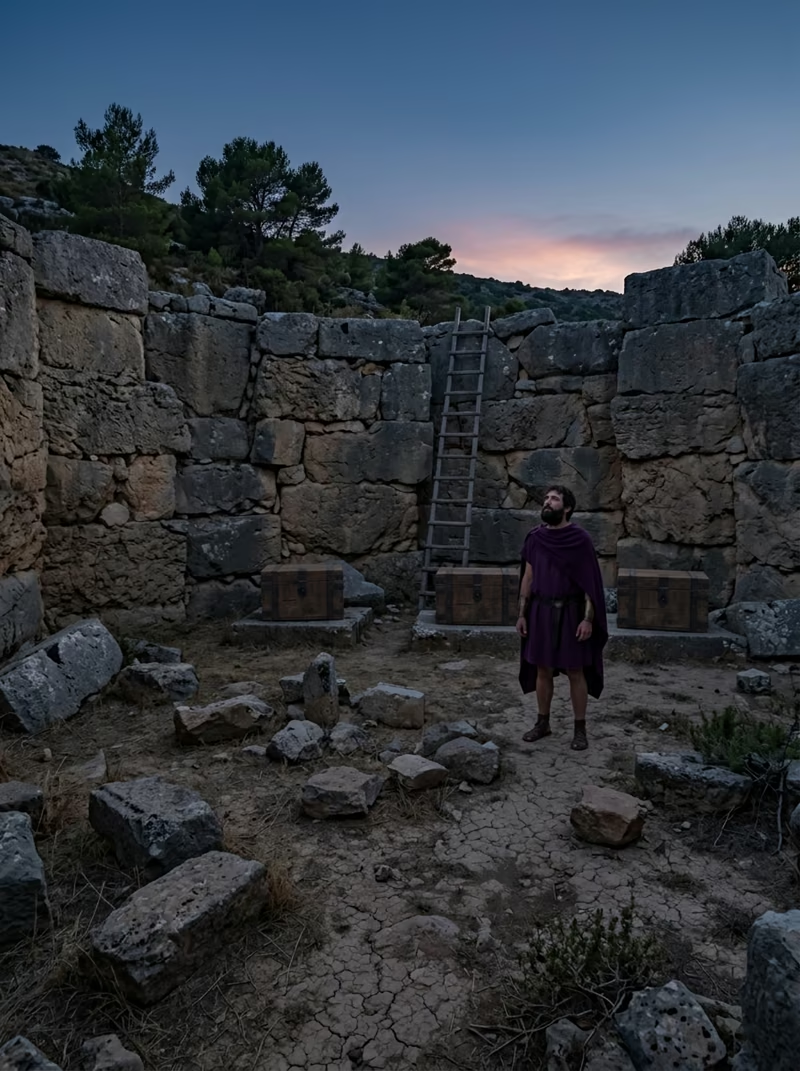
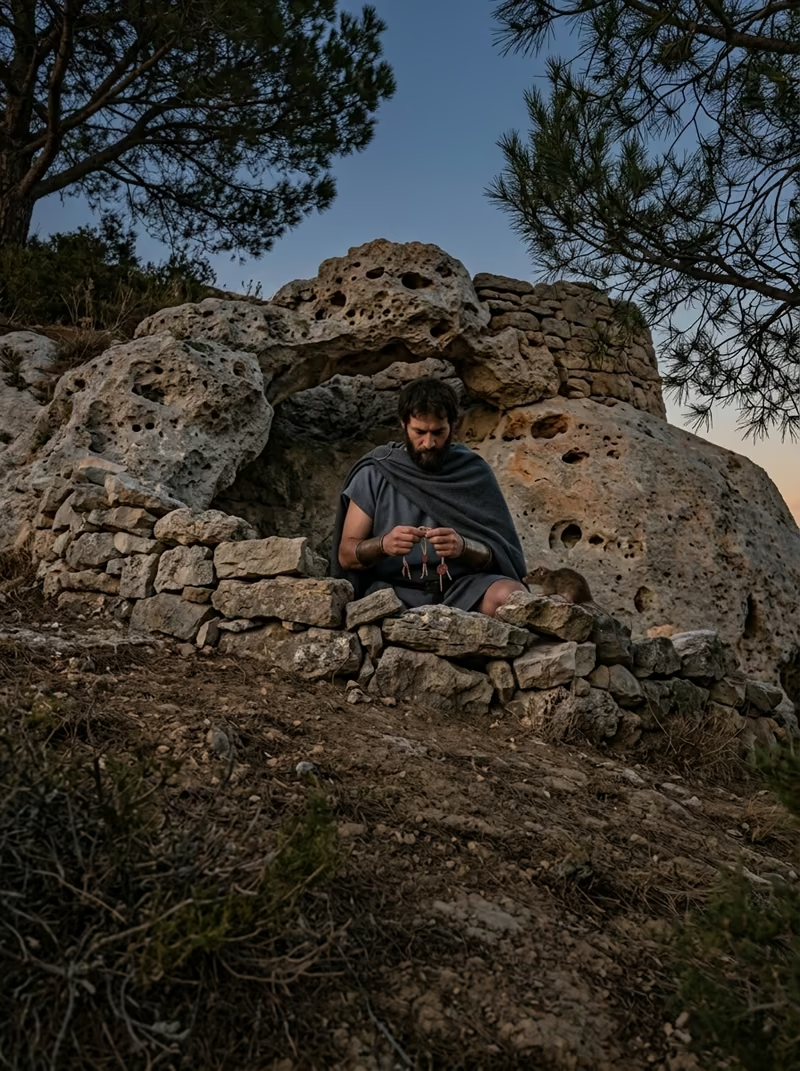
On the crown, Number 1, the chief, sits inside the ring wall with the loot. The wall has no way in: he climbed over by a timber ladder and drew it up after him, and he can see only sky. Numbers 2, 3 and 4 hold three lookout posts out on the slopes, each a hollow among crags with a rough, uneven dry-stone breastwork on its downhill side, each watching one approach. The hill's shoulders hide every post from the others, and the wall hides the chief from all of them, so that no man can see another. Nobody shouts, raises a banner or lights a brand: the tents below are listening, and a voice that every post heard at once would leave a lying chief no way to tell different men different things, and the crown's question would vanish.
The bandits never die in these books, but some of them may lie, and nobody below or above ever learns which. Each carries a seal ring cut with his own number, and an honest man's seal cannot be counterfeited. Their question, too, has two answers: hold the hill and keep the loot, or scatter and abandon it, all doing the same thing. Holding ties no man to his post: each holds from wherever he chooses, and the question is only hold or scatter. They know the camps are below, and nothing of what the mercenaries mean to do. On later nights they keep a scroll of the loot instead, one copy at each post.
The chief is a job as well as a man. In the crown's arrangements whoever's word is going round is "the chief" for that round, and the job passes from man to man. Number 1 holds it first.

Word passes on the crown only by rat. Each man has trained rats to run to each of the other posts. A man writes on a strip, rolls it into a bronze tube, ties it on a cord knotted with his own number round a rat trained for the post he is writing to, and lets it go. The wall has no gate, but its stones do not fit close, and a rat finds the chinks. What a rat carries is exactly what was written, and the knots say whose it is.
The runs between the posts are short and clear, and no rat has ever taken longer than a sandglass takes to run. Each post has a sandglass; the four were turned together once, at dusk on the first night before the posts were manned, and since no man leaves his place they are never turned together again. Sandglasses are the only timers on the crown.
Below, the ravens between the tents have no such bound: one may sit among the crows of the folds for the whole night. That is one of the two things that separate the ends of the hill. The other is the trouble each end fears: below, a man may die but never lies; above, nobody dies, but some men lie.
Every book on the crown keeps the same hill and the same four at the same posts. What changes from book to book is one condition of the night, never the place.
The first night: no wind, short bounded runs, glasses turned together; some men lie.
Later nights: a wind blows over the whole hill, and while it howls over the crown a rat may stay in its hole for
any time; it always drops in the end. The four keep the loot scroll, and the job of numbering its
entries passes from man to man.
Whatever the night, nothing is ever settled by force, nobody is ever found out, and the arrangements are judged only by what they guarantee.
What each part of the place stands for, so that a reader coming to any book here knows the model before the first chapter begins.
What each part of this place has in common with the real Greek world, so that a reader can tell what is borrowed from what is made up. Close means the real thing is much like it; loose means it is borrowed and changed; invented means the setting made it up; anachronism means the real thing is of another age. A dagger (†) marks a citation given from memory and not checked against the text.
| In the setting | The real precedent | How close |
|---|---|---|
| Place. Mount Phyle, a hill held by a small band | Phyle is a real border fortress on Mount Parnes in Attica. In 404 BC Thrasybulus seized it with a small band of exiles, and an attack by the Thirty failed in a snowstorm (Xenophon, Hellenica 2.4.2–3). The setting borrows the name and the situation of a small garrison on a hill that a larger force cannot take. | Close |
| Place. four camps with no pair in sight of one another | Greek armies camped in separate contingents round a besieged place; the Peloponnesian lines at Plataea are the standard example (Thucydides 2 and 3)†. | Loose |
| Place. a small ruined ring wall of rough cyclopean stone, solid all round | Later Greeks called the great walls of Mycenae and Tiryns “Cyclopean”, as if giants had built them (Pausanias 2.25.8)†, and Mycenae was re-occupied in Hellenistic times†. Those walls have gates, so a wall with no gate is the setting's own. | Loose |
| Place. three lookout posts out on the slopes: a hollow with a dry-stone breastwork | Dry-stone lookouts and field forts on Greek hillsides are common, and Attica had small hilltop forts (phrouria) beside Phyle†. | Close |
| Character. four bandits holding loot on a hill | Brigands and pirates were a fixture of the Hellenistic world, and bandit chiefs are stock figures in the Greek novels: Heliodorus's Egyptian herdsmen and Xenophon of Ephesus's robbers†. Why any one of them lies is never given, in the setting or in the model. | Close |
| Character. the chief, in purple | Purple dye from the murex was one of the costliest in the ancient world†, so a chief in stolen purple is plausible; the colour only tells the figures apart. | Close |
| Character. a liar among honest men, who may be the chief | Betrayal of a defended position is a staple of Greek war narrative, from Ephialtes at Thermopylae (Herodotus 7.213) onward, and Aeneas Tacticus gives much of his siege manual to guarding a city against its own men†. The paper's “Byzantine generals” are Lamport's own picture of an army round a city. | Close |
| Prop. a wind that drops | The Aegean's summer north wind (the etesiai, now the meltemi) blows by day and tends to die away at dusk†, and the Tower of the Winds in Athens names eight winds. | Close |
| Prop. rats as messengers, a cord knotted with the sender's number | No Greek army used rats; the setting says so. Apollo was “Smintheus”, lord of mice (Iliad 1.39)†, but that is a cult title, not a postal service. A knotted cord as a message is real: Darius left the Ionians a thong with sixty knots to undo one a day (Herodotus 4.98). | Invented |
| Prop. the sandglasses turned together at dusk | The hourglass is not attested before the fourteenth century AD (its earliest evidence is Lorenzetti's fresco of 1338), and the Greek instrument is the water-clock. The setting keeps the sandglass on purpose, a deliberate anachronism for narrative convenience: it can be turned over at a stroke, so that four men who cannot see one another start together. | Anachronism |
| Prop. seal rings cut with each man's number | Signet rings were the Greek proof of sender and of an unopened message: Polycrates' ring (Herodotus 3.41)†, and the seals Aeneas Tacticus describes for messages (31)†. | Close |
| Prop. the loot scroll, a copy at each post | Papyrus rolls were the ordinary Hellenistic form for lists and accounts, written in columns with new entries added at the end†. | Close |
| Prop. a timber ladder drawn up after the chief | Ladders and walls: the Plataeans' breakout used ladders over the besiegers' wall (Thucydides 3.20–24)†. | Close |
| Prop. strongboxes on a stone shelf | Treasure was kept in chests (kibōtoi) and temple treasuries†. | Close |
| Practice. no fire and no signal, because the other side is listening | Fire signals were real: the beacon stations of the Cyclades were called phryktoriai, and Polybius describes a signalling code (10.43–47). The weakness of fire signals is that the enemy can read them too. | Close |
| Practice. a hill that cannot be left unwatched, attack or hold | Councils of commanders voted on whether to fight or withdraw: Herodotus's account of the council before Salamis is the model (8.49–63)†. | Close |