A parliament whose members wander in and out as they please, which still passes laws that never contradict one another.
Read this first, and the book set in the Chamber can be read on its own. It describes the island of Paxos and the Chamber, where Lamport set his parliament.

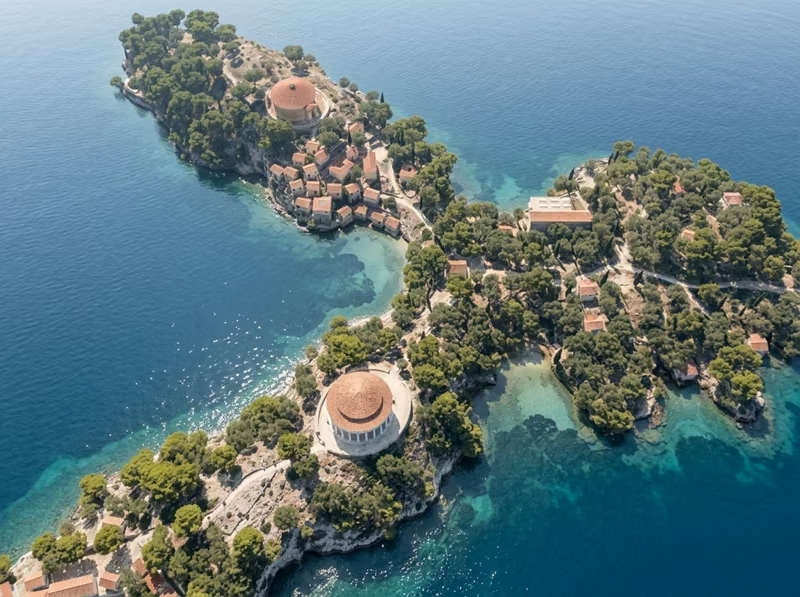
Paxos is shaped like a Y. Two arms reach north and face each other across a bay: the western arm holds the Chamber of the Paxon Parliament, the eastern arm the city of Schedia and its Tholos. The arms join at a fork, where the hall of two doors stands, and below the fork the stem widens into the body of the island, the scholars' coast. The island road runs up the stem, forks, and runs out along both arms.
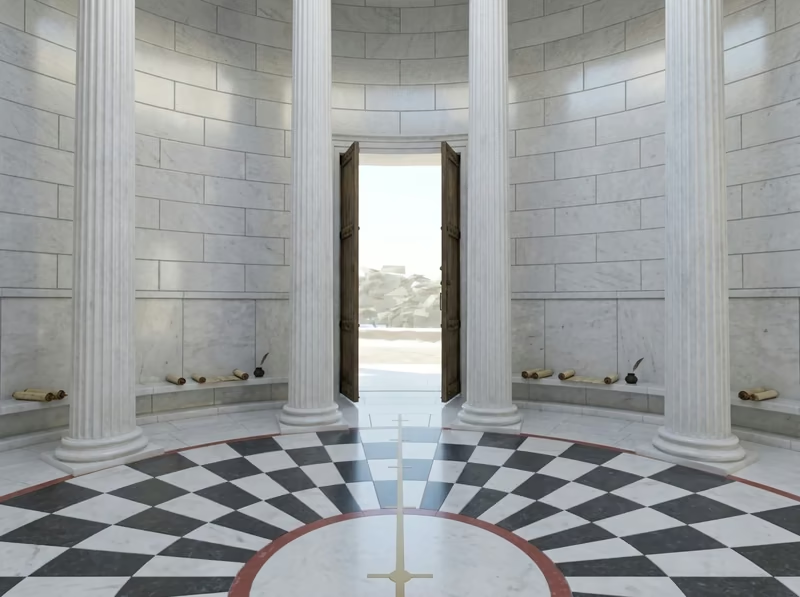
Paxos can read the sun. Unlike Arche in its trading season, the island tells time by day, and the Chamber has a meridian line. Word goes by messenger and by courier along the island's roads, and takes as long as it takes.
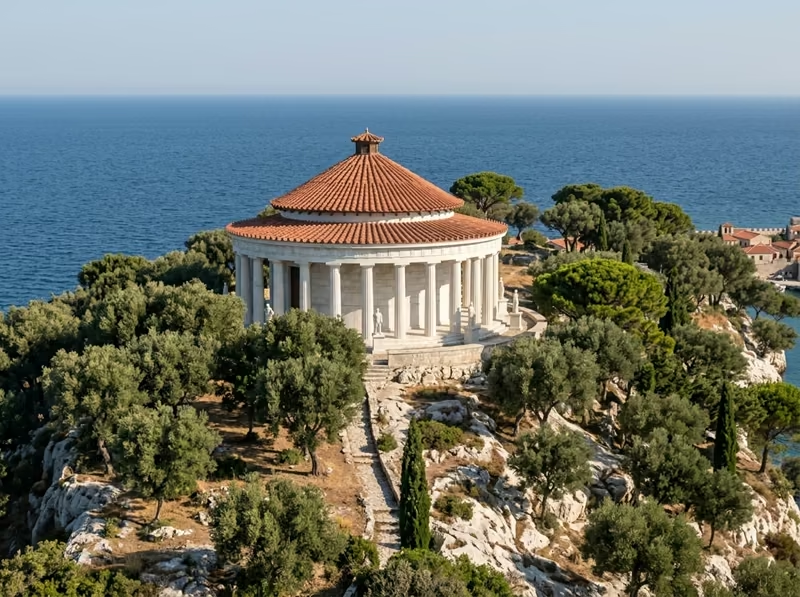
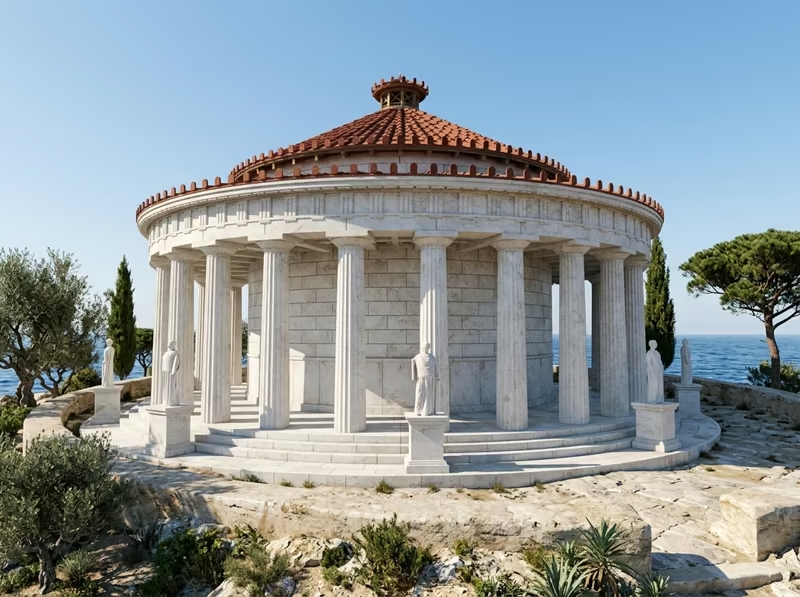
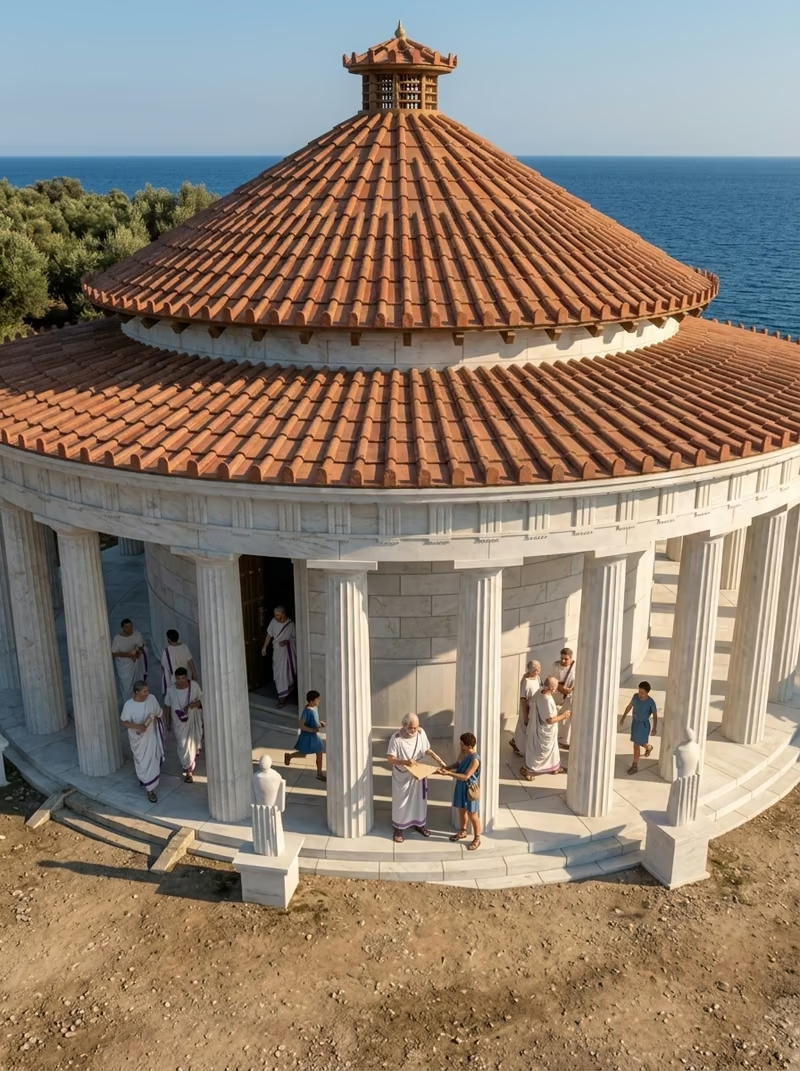
The Chamber is Lamport's, not ours, and it is not retold. It stands on the western arm, on the road to the harbour town at the arm's tip, looking across the bay at the Tholos of Schedia. It is drawn as a rotunda because Lamport gives it one physical property: its acoustics were poor, making oratory impossible, so legislators could communicate only by messenger. A round hall with hard stone walls under one conical roof held up by columns inside, with no podium and no head of the room, fits that description, and its one doorway, closed by a door that can be locked, lets legislators and messengers come and go.
The legislators are part-time. They wander in and out of the Chamber whenever they like, and any of them may be away for any length of time. Each keeps a scroll in which he writes the decrees that have passed, in order. Messengers carry word between them and take as long as they take; a messenger may even leave on a long voyage and never deliver his message. Nobody lies. The one thing the Parliament guarantees is that no two scrolls ever record different decrees under the same number, because any two majorities of legislators share a member.
The Parliament makes the law of Paxos: the western arm, the stem and the scholars' coast. Schedia, on the eastern arm, keeps its own laws, and the Parliament's decrees have never run there.


Lamport ends his paper with the Parliament's fall: a scribe's error names drowned sailors as the only legislators, government halts, and a coup and an invasion follow. Every other book in this series sets that ending aside, as a matter of convenience. In them the Parliament is still sitting, the Chamber still stands on the western arm, and the scholars of the island's coast still walk up to it.
What each part of the place stands for, so that a reader coming to any book here knows the model before the first chapter begins.
What each part of this place has in common with the real Greek world, so that a reader can tell what is borrowed from what is made up. Close means the real thing is much like it; loose means it is borrowed and changed; invented means the setting made it up; anachronism means the real thing is of another age. A dagger (†) marks a citation given from memory and not checked against the text.
| In the setting | The real precedent | How close |
|---|---|---|
| Place. the island of Paxos | Lamport's story puts a thriving mercantile Paxos in the Aegean and warns that it is not the Ionian island of Paxoi. Real Paxos is a small island in the Ionian Sea. | Invented |
| Place. the Y shape: a stem that forks into two arms round a bay | A whole island in this shape is rare; the parts are common. Chalkidiki is a peninsula that splits into three prongs, Pallene, Sithonia and Athos†, and Lesbos is cut by two deep gulfs, Kalloni and Gera, so that its land falls into lobes†. Sicily was called Trinakria, “three-cape”†, and Strabo likened the Peloponnese to a plane leaf†. The Aegean coast is a drowned one: the sea rose over a mountain country and filled its valleys†, and a bay between two ridges that run out as arms is just what that makes. | Loose |
| Building. the Chamber, a round hall ringed by a Doric colonnade under a conical tiled roof | Greek round halls were tholoi under conical roofs. The Athenian Tholos, a round building on the west side of the agora, housed the prytaneis (Aristotle, Constitution of Athens 44), and its roof was held up by columns inside†; the tholos at Delphi and the Philippeion at Olympia add a colonnade round the drum†. The tholos at Epidaurus has a Doric colonnade outside and a ring of Corinthian columns inside the drum†, and the Chamber has both. Like a real tholos, it has one door, which can be locked. | Close |
| Building. poor acoustics, so legislators send messengers | This is Lamport's own conceit, which the setting follows faithfully. The real Greek councils met in halls built for hearing, such as the bouleuteria of Priene and Miletus†. | Invented |
| Character. part-time legislators who wander in and out | The Athenian Council of Five Hundred sat by rota: each tribe's fifty served in turn for a tenth of the year, with one third of them on duty in the Tholos at any hour (Aristotle, Constitution of Athens 43–44). | Close |
| Character. messengers between legislators | Heralds and runners carried decrees and summonses in every Greek city†. | Close |
| Prop. a bronze meridian line on the Chamber's floor | Greeks told the hour by the shadow of a gnomon, and Meton set up a sun instrument, a hēliotropion, on the Pnyx in Athens to mark the solstices†. A line on a floor that a spot of sunlight crosses at noon is later: Augustus's meridian in Rome and the church meridians of the Renaissance†. | Loose |
| Prop. a legislator's scroll in indelible ink | Greek ink was soot in gum and could be wiped off with a sponge†, so indelible ink is the story's own; the scroll itself is the ordinary Hellenistic form of a record. | Loose |
| Prop. a decree and its number | Athenian decrees were dated by the year's chief magistrate and the number of the prytany, and cut in stone†. | Close |
| Practice. a decree passes by a majority | The Athenian Assembly voted by show of hands, and law-courts by pebbles; decisions went by simple majority†. | Close |