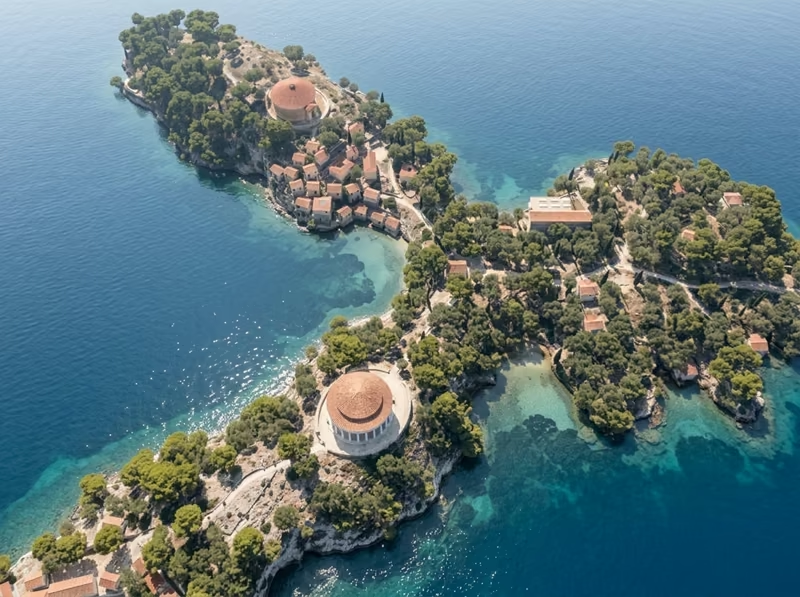
| Place. Homonoia, the scholars' coast | Homonoia, “concord”, was a Greek civic ideal and later a cult of the Hellenistic and Roman world†. | Close |
| Building. the libraries | The Library and Museum of Alexandria, and Pergamon's rival library, kept and collated copies of the works of Greek literature†. | Close |
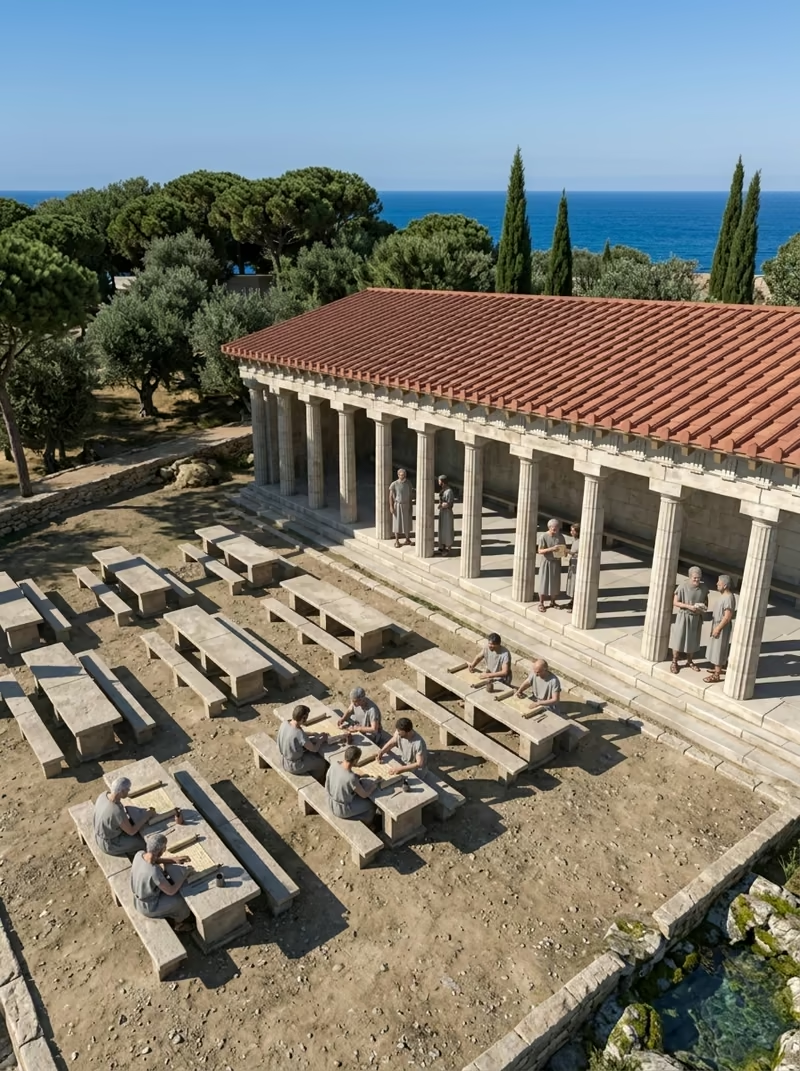
| Building. the stoa, where scholars pass on news | Zeno taught under the Stoa Poikile in Athens, which gave the Stoics their name†; philosophers and scholars gathered in colonnades. | Close |
| Building. the festival ground, where copyists compare whole collections once a year | Panhellenic festivals drew poets, rhapsodes and scholars from across the Greek world; the yearly collation itself is the setting's own. | Loose |
| Building. a stone table grooved in columns, with piles of pebbles | The Salamis Tablet, a marble counting board of the fourth century BC, was used for reckoning with pebbles†; psēphoi are pebbles used to count. | Close |
| Prop. white pebbles for copies made, black for copies lost | Jurors voted with pebbles of two kinds, as Athena's casting vote does in Aeschylus' Eumenides (734–753)†. Counting made against lost with the two colours is the setting's own. | Loose |
| Building. a hillside cut into terraces, a scribe at each | Greek sanctuaries were built on terraces cut into slopes, as at Delphi†. | Close |
| Building. the far terraces, a count kept in voting pebbles | Greek psēphoi were pebbles used to vote and to count, and the Greek for “to reckon” (psēphizein) comes from them†. | Close |
| Building. the courier landing | Hellenistic kings ran their own couriers, and merchant ships carried private letters†. | Close |
| Building. the ferry across the inlet, the one crossing between two parts of the coast | Short sea crossings were ordinary: the strait between the Attic shore and Salamis was crossed by boat†, and the Euripus was bridged only in 411 BC†. | Close |
| Character. scholars and copyists, readers, couriers | Zenodotus, Aristophanes of Byzantium and Aristarchus of Samothrace edited Homer at Alexandria, recording variant readings†; hemerodromoi were Greek couriers on foot. | Close |
| Prop. a scrap of papyrus carrying a new learning: that the Earth goes round the Sun | This is a real example: Aristarchus of Samos proposed it in the third century BC, as Archimedes reports in the Sand Reckoner, and Plutarch says that Cleanthes thought he should be charged with impiety for it†. | Close |
| Prop. the catalogue scroll, and the catalogue sum worked from all of it | Callimachus' Pinakes catalogued the Alexandrian library in some 120 scrolls†. The mark is the setting's own: sealed documents were common†, but no seal summed up a whole catalogue, and a digest is a modern device. | Invented |
| Prop. a notice of withdrawal, spread like an edition | Aristarchus and Zenodotus marked lines they judged spurious with the obelos and left them in the text†; Athenian decrees were sometimes struck from their stelai†. The setting's notice, which travels and cancels older copies, is its own. | Loose |
| Prop. the hot tablet, a wax tablet of the scraps a scholar is still telling | Wax tablets were the Greek everyday writing surface†. | Close |
| Prop. different editions of one work | Homer's text circulated in variant forms, among them the “city” editions that the Alexandrians collated†. | Close |
| Practice. collating copies line by line | The Alexandrian scholars collated manuscripts and marked disputed lines, as the setting says†. | Close |
| Practice. learnings spread by word of mouth, each carrier losing interest | Hesiod calls rumour a goddess, Pheme, who never wholly dies (Works and Days 763–764)†. Rhapsodes also spread the epics by recitation (Plato, Ion)†, and a rule credited to Solon or Hipparchus made them take over from one another in order†. | Loose |
| Practice. a work kept at several libraries, each holding its own copy | Athens kept an official copy of the tragedies and Ptolemy III is said to have borrowed it for Alexandria, giving a deposit and keeping the original (Galen on Hippocrates' Epidemics III)†. Several libraries holding copies of one work is ordinary; the three fixed home libraries are the setting's own. | Loose |
| Practice. the couriers' logbook of journey times | Herodotus describes the stages and days of the Royal Road from Sardis to Susa (5.52–54)†, and periploi record days of sailing between ports†. A logbook of the variation in a journey, from which odds are worked, is the setting's own. | Loose |
| Practice. a promise with odds: nine in ten you are handed the newest | Greek rhetoric argued from the likely, eikos (Antiphon's Tetralogies; Aristotle, Rhetoric 2.24)†; odds worked out from counts are not Greek. | Loose |
| Practice. a library lends a copy to a reader for a term | Ptolemy III is said to have borrowed Athens' official copy of the tragedies against a large deposit and kept the original, returning a copy (Galen on Hippocrates' Epidemics III)†. A term of loan is the setting's own. | Loose |
| Practice. corrections to several works bound under one cord, shown all together or not at all | Scrolls were tied and sealed in bundles†; showing a bundle only when complete is the setting's own. | Loose |
| Building. the reading room in every library, where a reader asks and corrects | Scholars read in the rooms and colonnades of the Museum and library at Alexandria†. | Close |
| Practice. wardens of a dormant notice named by lot | Athens filled most magistracies by lot, drawing names with an allotment machine, the klērotērion†. Drawing names to keep a notice is the setting's use of it. | Close |
| Practice. answering from whatever copy a library holds | The Alexandrian library is said to have seized books from ships in its harbour and returned copies†, so the copy a reader held really did depend on the shelf. | Loose |
| Practice. no assembly; nothing waits for a vote | The scholarly world had no governing body; the Museum was a royal foundation and its scholars answered to the king†. | Loose |