← The Books
Paxos · The Setting

Schedia and the Tholos

A city with laws of its own, governed from a round hall like the Chamber's, with a podium at its centre.

Read this first, and the book set in Schedia can be read on its own. It describes the island of Paxos, the city on its eastern arm, and the Tholos where its law is made.

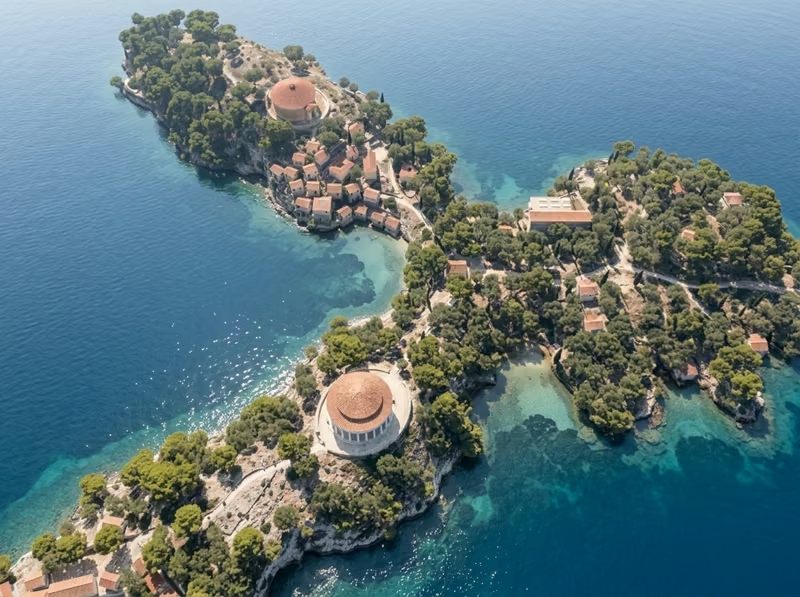
Paxos from the air: a Y-shaped island whose two arms face each other across a bay, a white colonnaded round hall under a conical roof on one arm and, on the other, a town beside a round hall with a conical red-tiled roof, the arms joining at a fork above the broad body of the island.

The Island of Paxos

Paxos is shaped like a Y. Two arms reach north and face each other across a bay: the western arm holds the Chamber of the Paxon Parliament, the eastern arm the city of Schedia and its Tholos. The arms join at a fork, where the hall of two doors stands, and below the fork the stem widens into the body of the island, the scholars' coast. The island road runs up the stem, forks, and runs out along both arms.

Paxos can read the sun. Unlike Arche in its trading season, the island tells time by day, and the Chamber has a meridian line. Word goes by messenger and by courier along the island's roads, and takes as long as it takes.

A City of Its Own

Schedia is a small city on the eastern arm, above a sheltered cove on the bay. Its name means raft. It was founded by settlers from a different mother city, who came by sea and brought their founders' laws with them, and the Parliament's decrees have never run on the eastern arm. That was ordinary Greek practice: the small island of Amorgos held three independent cities, each settled from elsewhere and each with its own laws.

So Paxos has two cities and two law scrolls. Each covers its own city, and the two never contradict each other. There is no quarrel between them for either to settle; Schedia simply keeps its law another way.

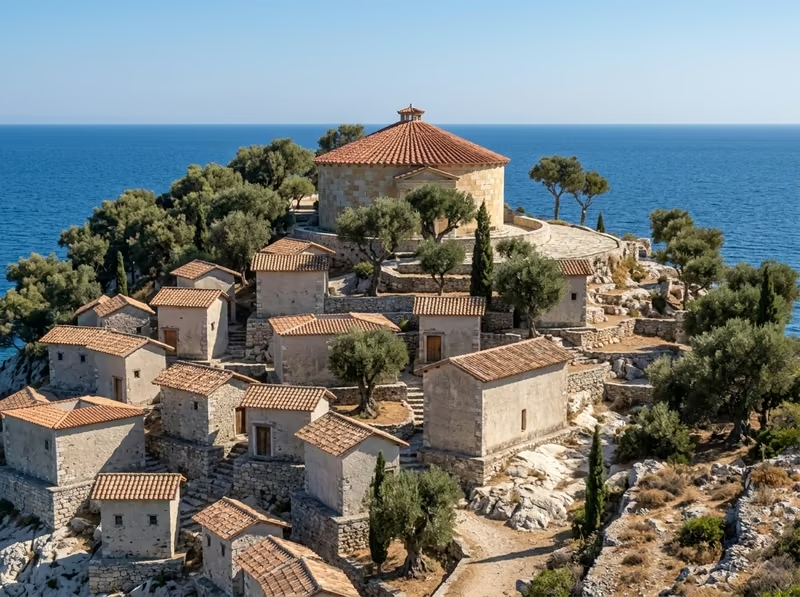
Schedia from across the bay: a town of red-tiled stone houses climbing a rocky slope, and above it on a paved terrace among olive trees the Tholos, a round honey-coloured hall with a conical tiled roof, a small lantern and a porch, the sea behind.

The Tholos

Schedia is governed from its Tholos, a round hall on a terrace above the town that faces the Chamber across the water. It is the same kind of hall. Its acoustics are just as poor, so nobody can be heard across it and everything goes by messenger, and its legislators serve part time, coming and going by its one door. The council has five legislators, Okios, Liskovia, Kleon, Melissa and Theron, each with a copy of the law scroll at a bench of their own. The Tholos has one thing the Chamber lacks: a podium at the centre.

Nobody can be heard from the podium either. It is an office, not a pulpit. Only the legislator who holds it may propose; the others keep their law scrolls on the benches round the drum and write down what the podium's messengers bring. Citizens at the doors send their petitions to the podium, and a petition that reaches a bench instead is sent back with the name of the holder. The podium stands where every bench is the same distance away, so its messengers run out from the centre, where in the Chamber they cross the floor in every direction.

A board hangs on the podium with a number and the name of the legislator who raised it, and every note the podium sends carries that number. When the podium falls silent, any legislator who notices may raise a higher board. Its new holder first gathers what a majority of the benches hold, so that nothing a majority knew is lost. A holder who stepped out and missed the new board can go on sending notes under the old one, but settles nothing: any majority they reach includes a legislator who has taken the new board and refuses the old number.

The law is kept in wax, not ink. Each legislator's tablets stay on their bench and are smoothed when they go home; only the bench's name and the last board it served under are cut into its stone. A legislator who steps out comes back to their tablets. One who goes home comes back to smooth wax and must be brought up to date from the others. If a majority went home at once, the law would be lost.

The name is Athenian. In Athens the Tholos was the round building of the prytaneis, the committee on duty in turn, with one member presiding.
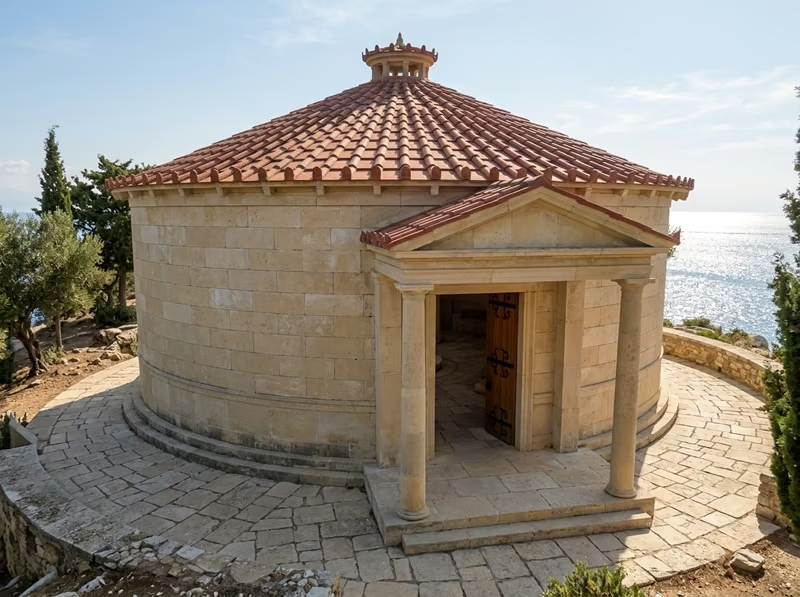
The Tholos from its paved court: a plain round drum of honey limestone on a stepped base, a conical roof of red tiles with a louvred lantern, and a small two-column porch with a pediment; its timber door stands open on the paved floor inside.
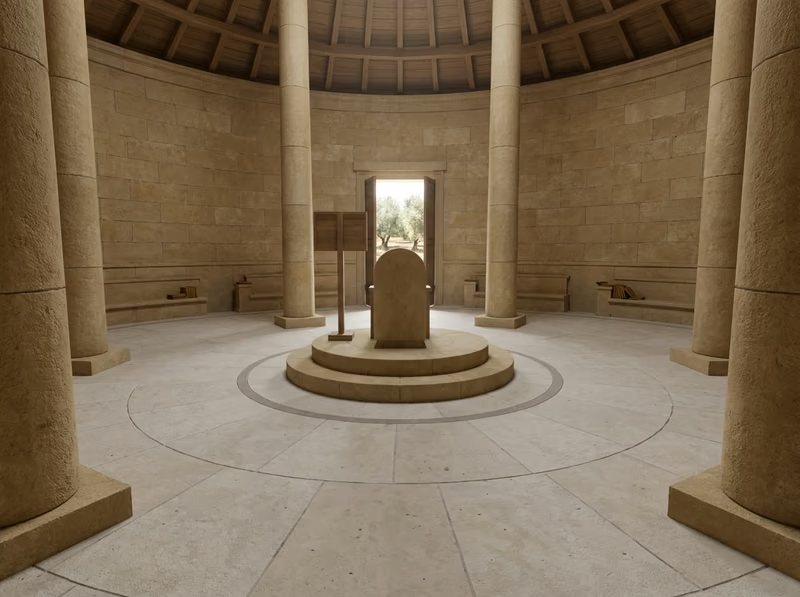
Inside the Tholos: a round stone hall under a timber roof, six plain columns, low stone benches along the wall, some with a stack of wax tablets, and at the centre a two-step round podium with a high-backed stone chair seen from behind and a blank board on a post; the open door beyond looks out on olive trees.

The Setting and the Papers

What each part of the place stands for, so that a reader coming to any book here knows the model before the first chapter begins.

In the setting
What it stands for
the benches round the drum, one law scroll each
⟷
The replicas (cohorts) of one group.
the holder of the podium
⟷
The primary, the leader.
the others writing down what the podium sends
⟷
Backups.
citizens at the doors, petitioning the podium
⟷
Clients, who deal only with the primary.
a higher board on the podium
⟷
A view change with a new, higher view number.
gathering what a majority of the benches hold
⟷
Recovering state from a majority, so committed work survives.
wax tablets, smoothed when their holder goes home
⟷
Volatile state, lost in a crash; a majority remembering is what keeps it safe.

Reality Checks

What each part of this place has in common with the real Greek world, so that a reader can tell what is borrowed from what is made up. Close means the real thing is much like it; loose means it is borrowed and changed; invented means the setting made it up; anachronism means the real thing is of another age. A dagger (†) marks a citation given from memory and not checked against the text.

In the settingThe real precedentHow close
Place. Schedia, a city that keeps its own laws on the eastern armSchedia is the Greek word for a raft, as in Odysseus' raft (Odyssey 5)†. A city founded from a different mother city kept its own laws: Amorgos held three cities in Classical times, Minoa from Samos, Aigiale from Miletus, Arkesine from Naxos, though the Naxian settlement is not securely attested until later. Lesbos held five (Herodotus 1.151)†.Close
Building. the Tholos, a plain round hall with a podiumThe building follows the Athenian Tholos: a plain drum with no colonnade outside, six columns inside carrying a conical tiled roof, and a porch at its one door†. The Athenian Tholos housed the committee on duty, with one member presiding for a day and a night chosen by lot (Aristotle, Constitution of Athens 44). The podium is the setting's version of that president's place; the real president was chosen by lot, not by a numbered board.Close
Character. a council of five, a majority of threeSparta had five ephors, elected each year†. Councils and colleges of other sizes were common.Loose
Character. the five told apart by colour; plain Greek names for the seatsKleon, Theron and Melissa are ordinary Greek names (Kleon was an Athenian politician, Theron a tyrant of Akragas)†. Colours only tell the figures apart.Close
Character. young men who run the lines from the podiumHeralds and runners again†.Close
Prop. wax tablets smoothed when their holder goes homeWax tablets were the Greek notebook; the stylus's flat end smooths them. Plato uses a wax block as his image of memory (Theaetetus 191c–d)†.Close
Prop. a bench's name cut into its stoneSeats in the Theatre of Dionysus at Athens were inscribed with the names of the priests and officials who held them†.Close
Practice. a higher board raised when the podium falls silentAthens renewed its presidency daily by lot. A new holder taking a higher board number is the setting's rule, not a Greek one.Invented

The Book Set Here

One Leader at a Time how Schedia's Tholos keeps one law scroll with one holder of the podium at a time, and how a new holder takes over without losing anything the last one promised. Oki & Liskov 1988