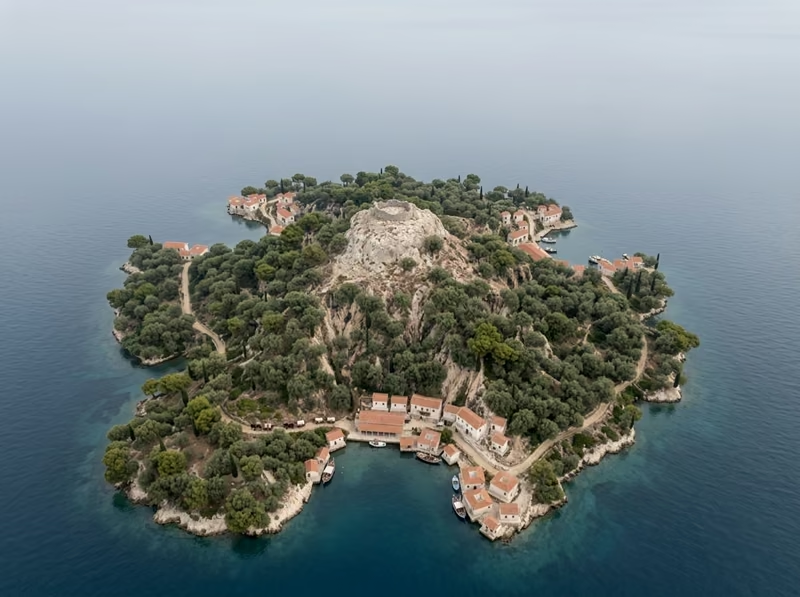
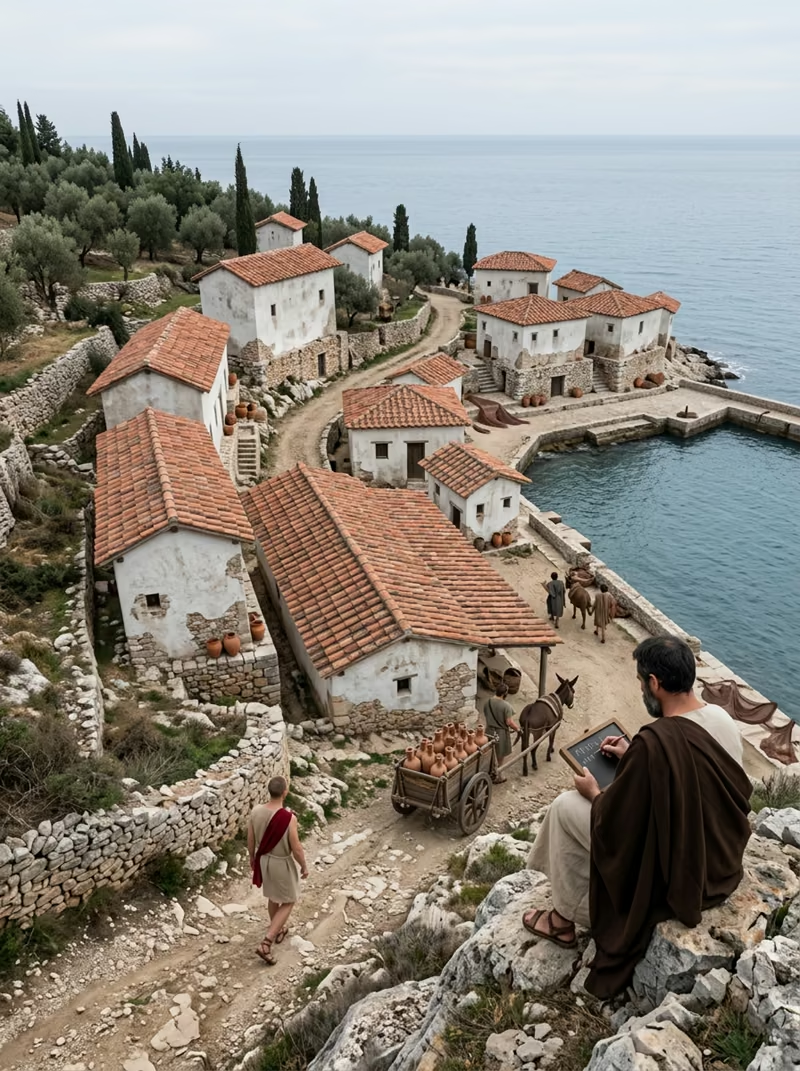
| Place. Arche, the island | The name is the Greek word archē, “beginning, first principle, rule”. For a round island with one great massif, the nearest real match is Samothrace, whose mountain Homer makes Poseidon's lookout over Troy (Iliad 13.12–14)†. The geometry itself is invented. | Loose |
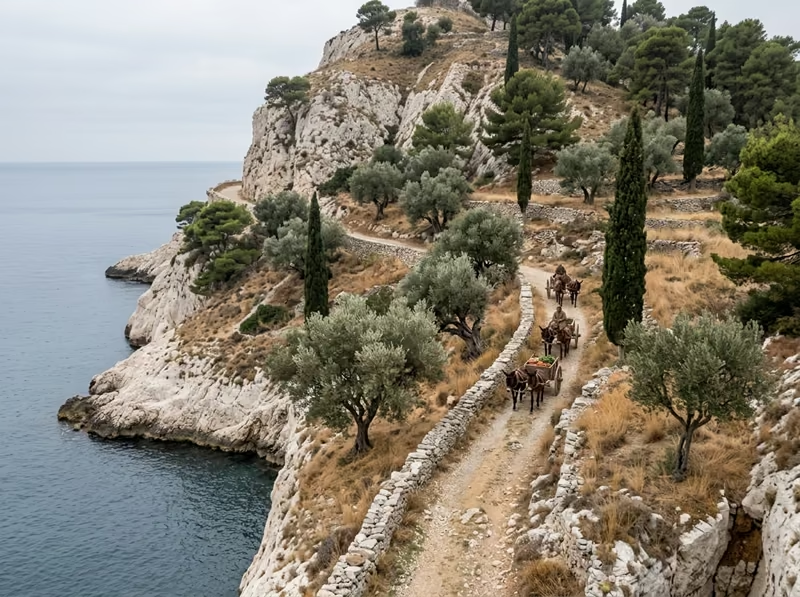
| Place. the ring road, one lane each way, no overtaking | The real cliff road of the Greek coast is the Scironian road from Megara to Corinth. In classical times it was a ledge fit for walkers and pack animals; the emperor Hadrian widened it so that vehicles could pass one another in opposite directions (Pausanias 1.44.6). A lane each way is a Roman standard, so a Hellenistic cliff road would be single track. | Loose |
| Place. three harbour towns on terraces round a harbour | Hellenistic trading harbours such as Delos and Rhodes: terraced towns of courtyard houses, with warehouses and quays at the water†. | Close |
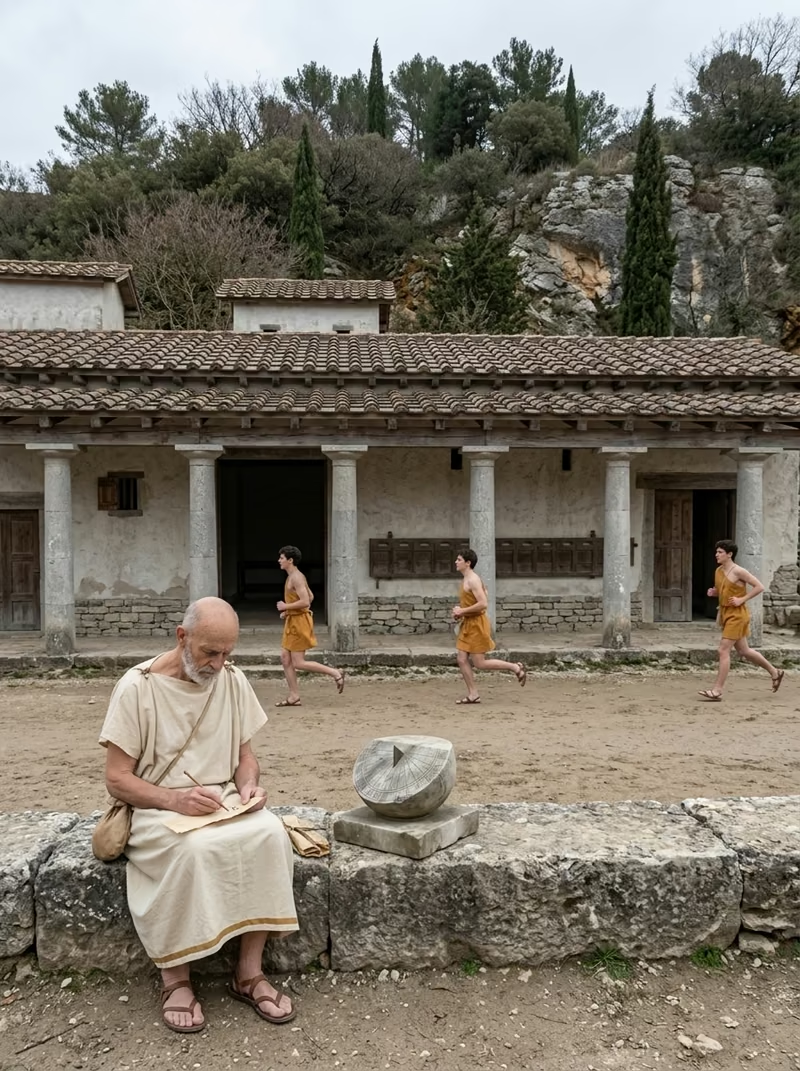
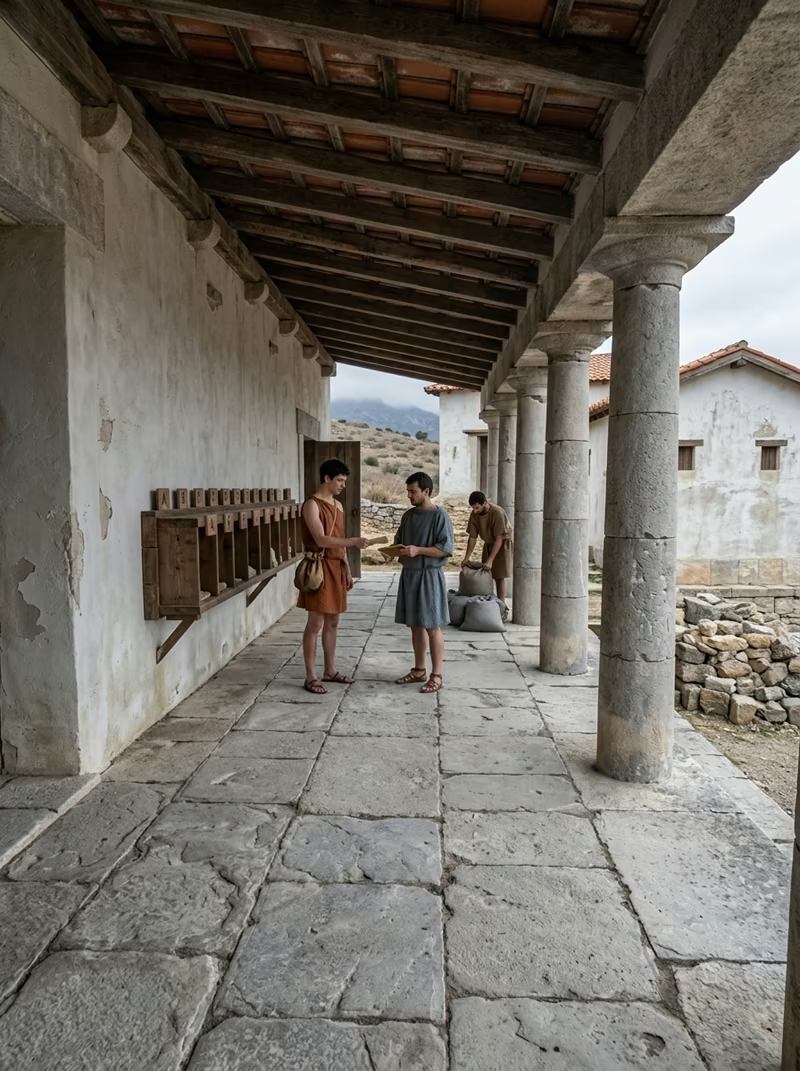
| Building. a house: one long range, lime-plastered rubble walls, a Doric portico along the road, a gabled tile roof | Plastered rubble walls (the “masonry style” of Delos) and a Doric colonnade facing a public way, as on the stoas of Athens and Pergamon†. The office, gate and storehouse under one roof is the setting's own arrangement. | Close |
| Building. a portico of plain Doric columns along the road | Greek Doric columns had no base: the shaft stands directly on the top step of the platform, the stylobate†. | Close |
| Building. a gabled tile roof of flat pan tiles under narrow cover tiles, with a decorated tile at each eave end | The Corinthian roof system: flat terracotta pan tiles, ridged cover tiles over the joints, and antefixes at the eave†. Sparta's Laconian roofs used curved tiles throughout†, so a curved tile is Greek too, but the flat and cover pair is the standard. The timbers beneath were hewn by adze and saw-pit, not milled†. | Close |
| Building. port-town houses facing inward, blank street walls, a door and a few small high windows | The courtyard houses of Olynthus and Delos present blank walls to the street and open onto a court†. | Close |
| Building. the board of requests at House 3's gate, numbered slots and a peg | The klērotērion, a stone slab with columns of slots into which citizens' bronze tokens were set, used in Athens to allot jurors and officials. It sorted by lot, not by arrival, so the board is a loose borrowing. | Loose |
| Building. the customs seat | Greek harbours levied a tax on goods landed; Athens took a fiftieth at the Piraeus†. | Close |
| Building. the shared storehouse cut into the rock beside the road | Greek rock-cut cisterns and store-rooms exist, but a store shared between rival trading houses is the setting's own device. | Invented |
| Character. the three houses, known by number | Hellenistic commerce ran through individual merchants and bankers rather than numbered firms; the nearest paper trail is the estate archive of Zenon, a Ptolemaic manager of the third century BC†. Numbering the houses is a series rule, so that none has a character of its own. | Loose |
| Character. the accountant and the clerks | Clerks kept dated accounts of receipts and shipments; the Zenon papyri show the work†. The accountant's Greek name follows the series practice of Hellenising the authors. | Close |
| Character. messengers on foot, bare-headed, in an ochre exōmis and strapped sandals, a hide pouch | The hemerodromoi, “day-runners”, such as Pheidippides (Herodotus 6.105)†. The exōmis is one woven rectangle, belted, with one shoulder bare†; sandals were simple strapped soles†; a traveller's bag was a soft hide pēra†. The traveller's hat, the petasos, is Hermes' emblem, but the setting leaves it off: on a runner it reads as a modern brimmed hat. A pinched-crown hat, a sleeved tailored shirt, a buckled sandal and a stitched flap bag are all of a later age. | Close |
| Character. loaders at the storehouse door | Dock and warehouse labour was done by slaves and hired men†. | Close |
| Character. the goatherd who crosses the mountain | A local who knew the hill path that no army could see: Ephialtes of Malis showed the Persians the Anopaia track round the pass of Thermopylae (Herodotus 7.213–218)†. | Close |
| Character. bandits who take carts on the road | Brigandage and piracy were constant in the Hellenistic world, and cargoes were lost as they would be to a sale. | Close |
| Prop. slips of papyrus | Papyrus was the ordinary Hellenistic writing material for letters and accounts. | Close |
| Prop. numbers written as Greek letters | The alphabetic numerals, Α for one, Β for two, were in use from the Hellenistic period†. | Close |
| Prop. water-clocks that disagree; a sundial dead under cloud | Athenian courts timed speeches with the klepsydra (Aristotle, Constitution of Athens 67), and the Tower of the Winds in Athens combined sundials with a water-clock. Greek hours also varied in length with the season†, so there really was no common hour. | Close |
| Prop. the red sash on the messenger who carries the marker | Heralds were sacrosanct under Hermes, and killing them was thought to bring a curse: the Spartans' killing of Persian heralds is the famous case (Herodotus 7.133–137)†. A red sash itself is the setting's own. | Loose |
| Prop. carts, mules, oil jars, merchant ships | The Kyrenia ship, a fourth-century BC merchantman found off Cyprus, carried wine jars, millstones and almonds†; mule and ox carts took goods on land. | Close |
| Prop. the houses' account scrolls | Hellenistic accounts were kept on papyrus rolls and sheets and on wax tablets; the Zenon papyri are the surviving archive of one such manager†. | Close |
| Prop. the tally kept in a counting room | Greek reckoning used pebbles on a counting board; the marble Salamis tablet is an example†. | Close |
| Practice. requests served in the sequence placed | Athens preferred the lot and the rota to a queue; first come, first served is the setting's own rule. | Invented |
| Practice. one house at a time in the shared storehouse | The president of the Athenian prytaneis, chosen by lot for a day and a night, kept the keys of the treasuries and the public seal (Aristotle, Constitution of Athens 44). A single key-holder is the real form of mutual exclusion. | Loose |
| Practice. counting the stock without stopping the trade | Temples and fleets were inventoried each year (the Delian temple accounts, the Athenian naval lists)†, but those were counted at rest. Counting a moving trade is the setting's problem. | Loose |
| Practice. trade in the cloudy season | Hesiod advises against sailing in winter (Works and Days 618–694)†, so the houses' trade is by road, which fits. | Close |