← The Books
Paxos · The Setting

The Hall of Two Doors

A hall at the fork of the island that rules on nothing, and only sorts every question into one of two doors.

Read this first, and the book set in the hall can be read on its own. It describes the island of Paxos and the hall at its fork, between the assemblies and the scholars.
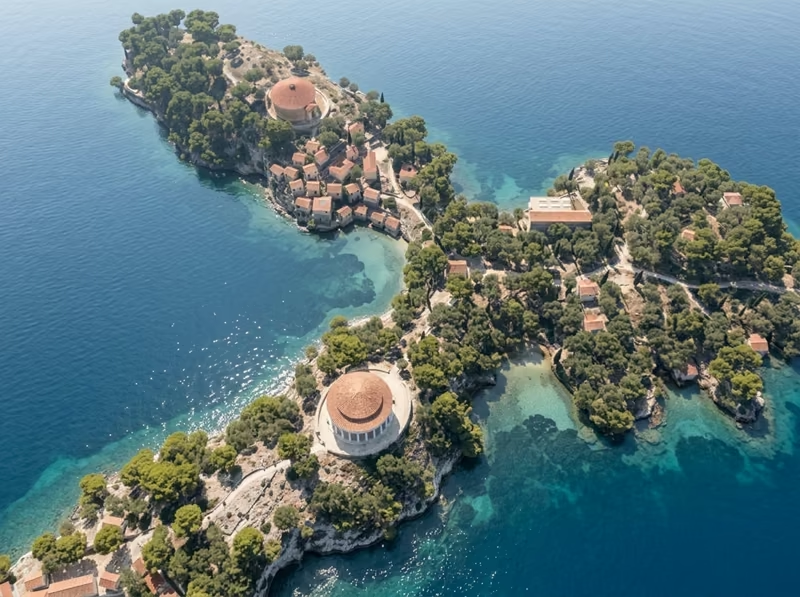
Paxos from the air: a Y-shaped island whose two arms face each other across a bay, a white colonnaded round hall under a conical roof on one arm and, on the other, a town beside a round hall with a conical red-tiled roof, the arms joining at a fork above the broad body of the island.

The Island of Paxos

Paxos is shaped like a Y. Two arms reach north and face each other across a bay: the western arm holds the Chamber of the Paxon Parliament, the eastern arm the city of Schedia and its Tholos. The arms join at a fork, where the hall of two doors stands, and below the fork the stem widens into the body of the island, the scholars' coast. The island road runs up the stem, forks, and runs out along both arms.

Paxos can read the sun. Unlike Arche in its trading season, the island tells time by day, and the Chamber has a meridian line. Word goes by messenger and by courier along the island's roads, and takes as long as it takes.

The Hall

The hall of two doors stands at the fork of the island, on common ground that belongs to neither city, as the Messon on Lesbos was the common sanctuary of that island's cities. It has two doors and no more. One faces north, up the bay between the arms, towards the Chamber and the Tholos: the two bodies on Paxos that assemble. The other faces south, down the stem, towards the scholars' coast, which does not.

The hall does not rule on anything. It sorts. Every question brought to it leaves by the door its own shape decides.

The hall of two doors from the air: a small gabled limestone hall under a tiled roof where the island road forks, a scholar walking to its door and a messenger walking up the road towards the white round hall on the height beyond.

Two Kinds of Question

Some questions only grow. Has at least one copy of this work been made? can be answered yes as soon as it is true, and once it is yes it is yes for ever, whatever news comes later. A question of that kind needs no assembly, and it leaves by the scholars' door.

Other questions rest on absence. Is this every copy that has been made? or Has no one claimed this? can be answered only by hearing from everyone, since a single late letter could overturn the answer. A question of that kind needs everyone to wait on everyone, and it leaves by the door of the assemblies.

Putting both cities and the scholars on one island makes the difference a walk: the scholars could take any question to an assembly, and the hall shows which questions need one.

The Setting and the Papers

What each part of the place stands for, so that a reader coming to any book here knows the model before the first chapter begins.

In the setting
What it stands for
a question brought to the hall
⟷
A program or query.
a question that only grows
⟷
A monotonic query.
a question that rests on absence
⟷
A non-monotonic query.
the scholars' door
⟷
No coordination needed.
the door of the assemblies
⟷
Coordination needed.
the hall sorting and never ruling
⟷
The CALM theorem: coordination is needed exactly when a program is not monotonic.

Reality Checks

What each part of this place has in common with the real Greek world, so that a reader can tell what is borrowed from what is made up. Close means the real thing is much like it; loose means it is borrowed and changed; invented means the setting made it up; anachronism means the real thing is of another age. A dagger (†) marks a citation given from memory and not checked against the text.

In the settingThe real precedentHow close
Building. a hall on common ground that belongs to neither cityThe Messon sanctuary of Zeus, Hera and Dionysos was the common sacred ground of the cities of Lesbos (Alcaeus fr. 129), and the Panionion on Mycale served the Ionian cities (Herodotus 1.141–148)†.Close
Building. two doors, one to the assemblies and one to the scholarsThe hall's arrangement is the setting's own; the Greek parallel is a shared sanctuary with two kinds of business.Invented
Practice. a closing notice that names the notices before it, a manifestAthenian treasurers handed over to their successors inscribed inventories of the sacred treasures, listing each item (the Parthenon inventories)†; closing a list by naming its contents is the setting's own use.Loose
Practice. the canon, the works the coast will keep and whose citations decide what else is keptAristophanes of Byzantium and Aristarchus drew up canonical lists of approved poets and prose authors at Alexandria†.Close
Practice. each question leaves by the door its own shape decidesThe Athenian Council sorted business before it went to the Assembly with a preliminary resolution (probouleuma)†, but sorting by whether a question rests on absence is the theorem's own.Loose
Practice. a question on common groundNeutral meeting places of cities existed (the Amphictyony at Delphi and Thermopylae)†.Close

The Books Set Here